
overview
"Is there a market for my Idea?"
This was the question I had to answer my client within 5 weeks.
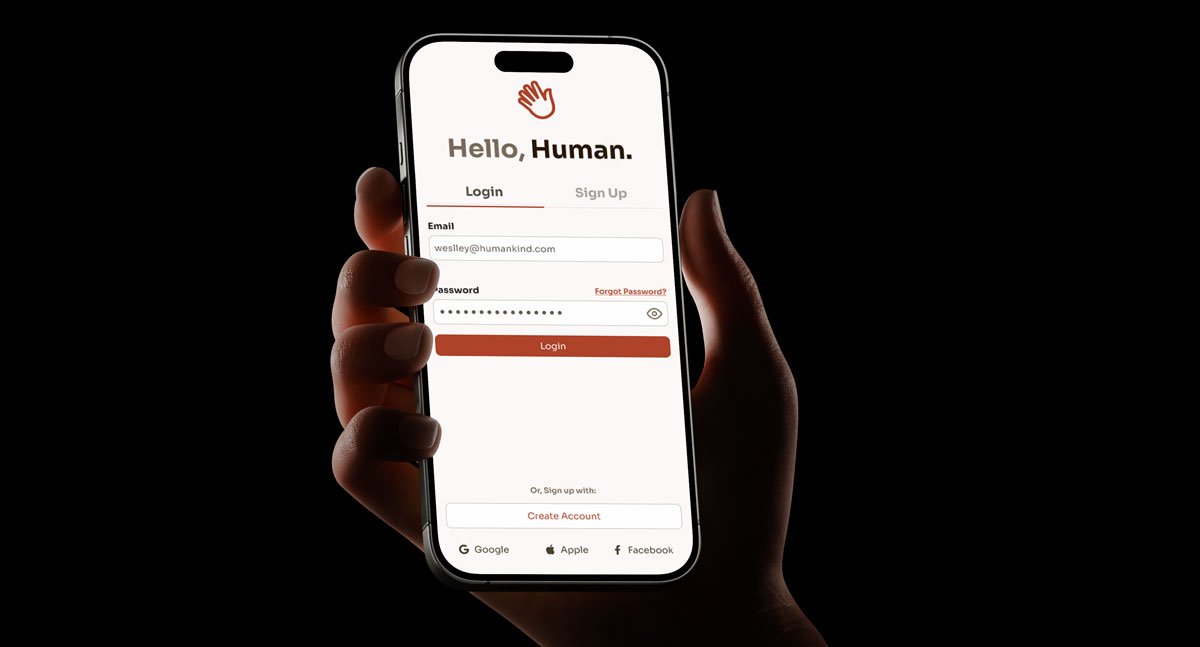
Peer to peer lending? Not yet
My client was well mentored, he wanted to make a P2P lending platform. He understood that this was beyond his current scope, and thought about what the MVP would look like.
Goals
Understand if there is a need for the idea
Identify Market Risks
Avoid build something unfeasible
Does using blockchain increase perceived trust?
Identify monetization options
Create content to create a Landing Page to capture investors and pitch deck
Prototype an MVP
Planning
Presenting the stakeholders and the team how design will be working.
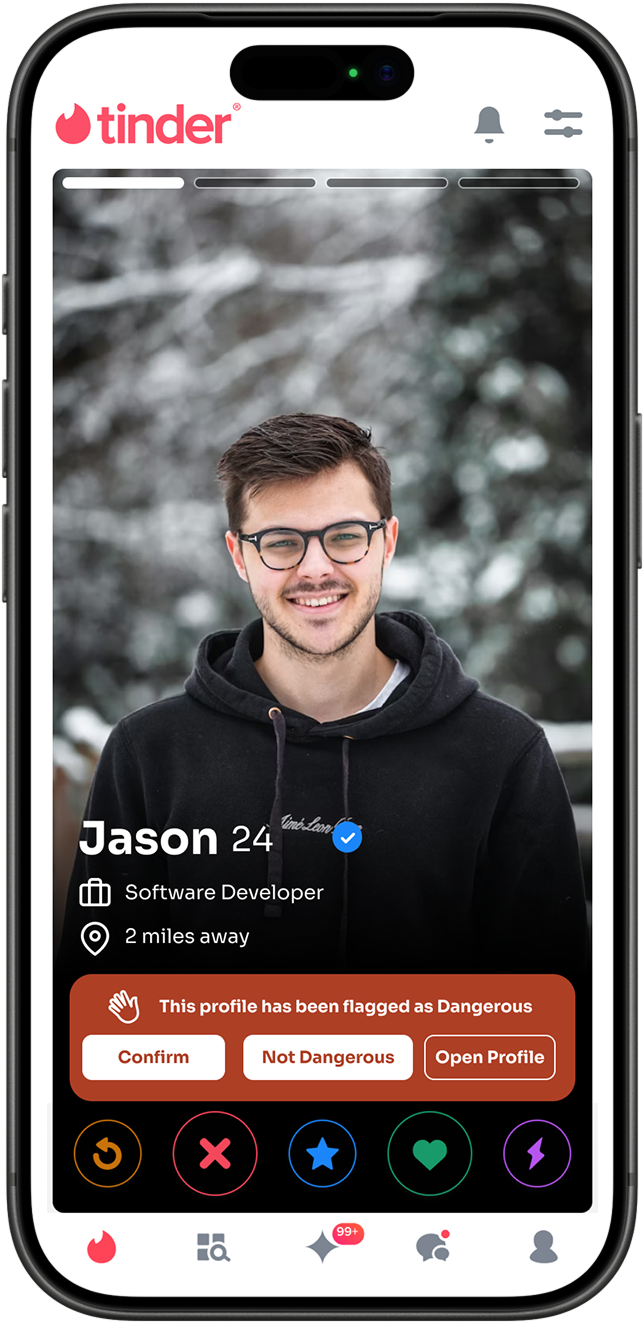
User Story
"I want to know if someone is dangerous before interacting with them"
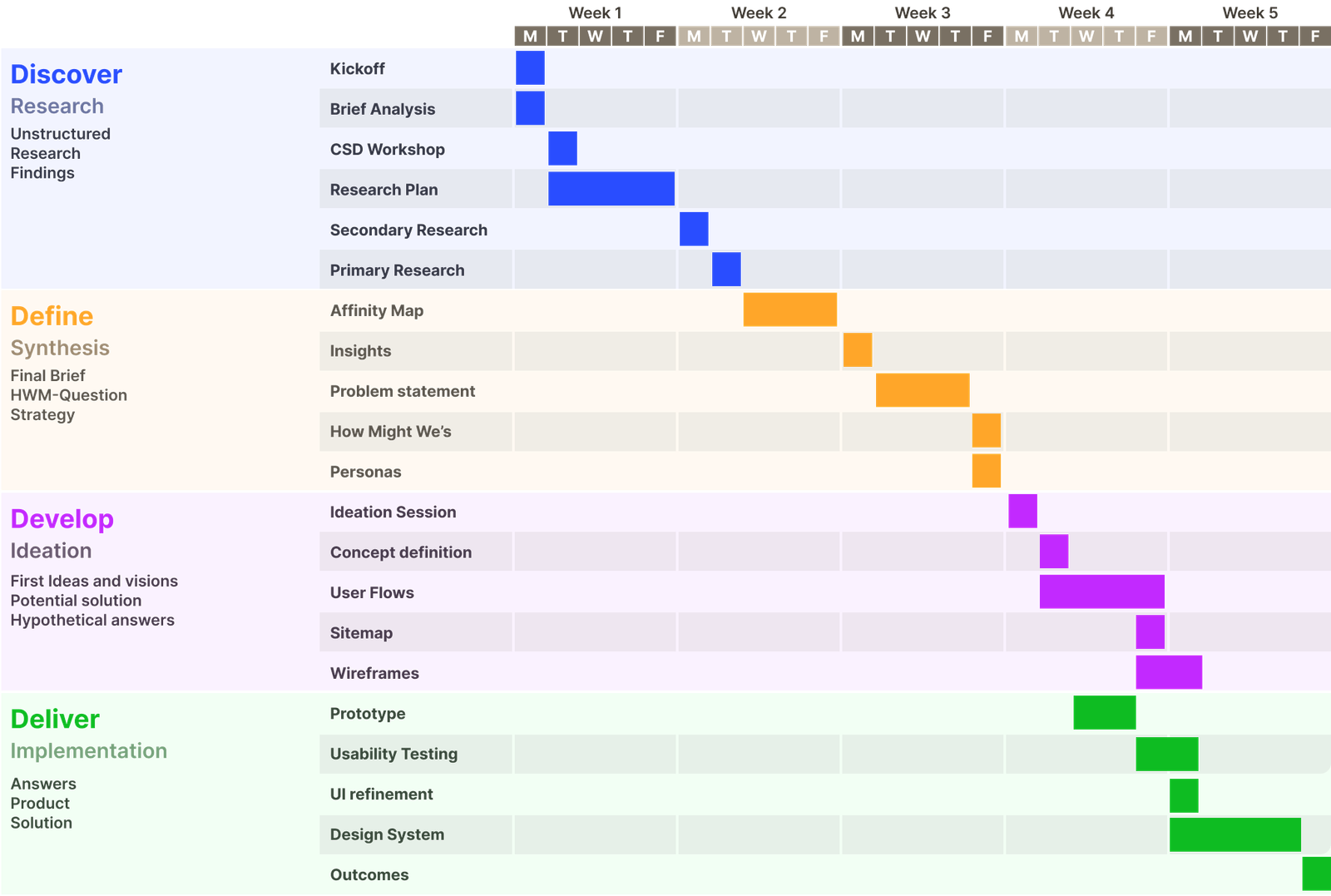
Design Roadmap
What I will be working in the following days.
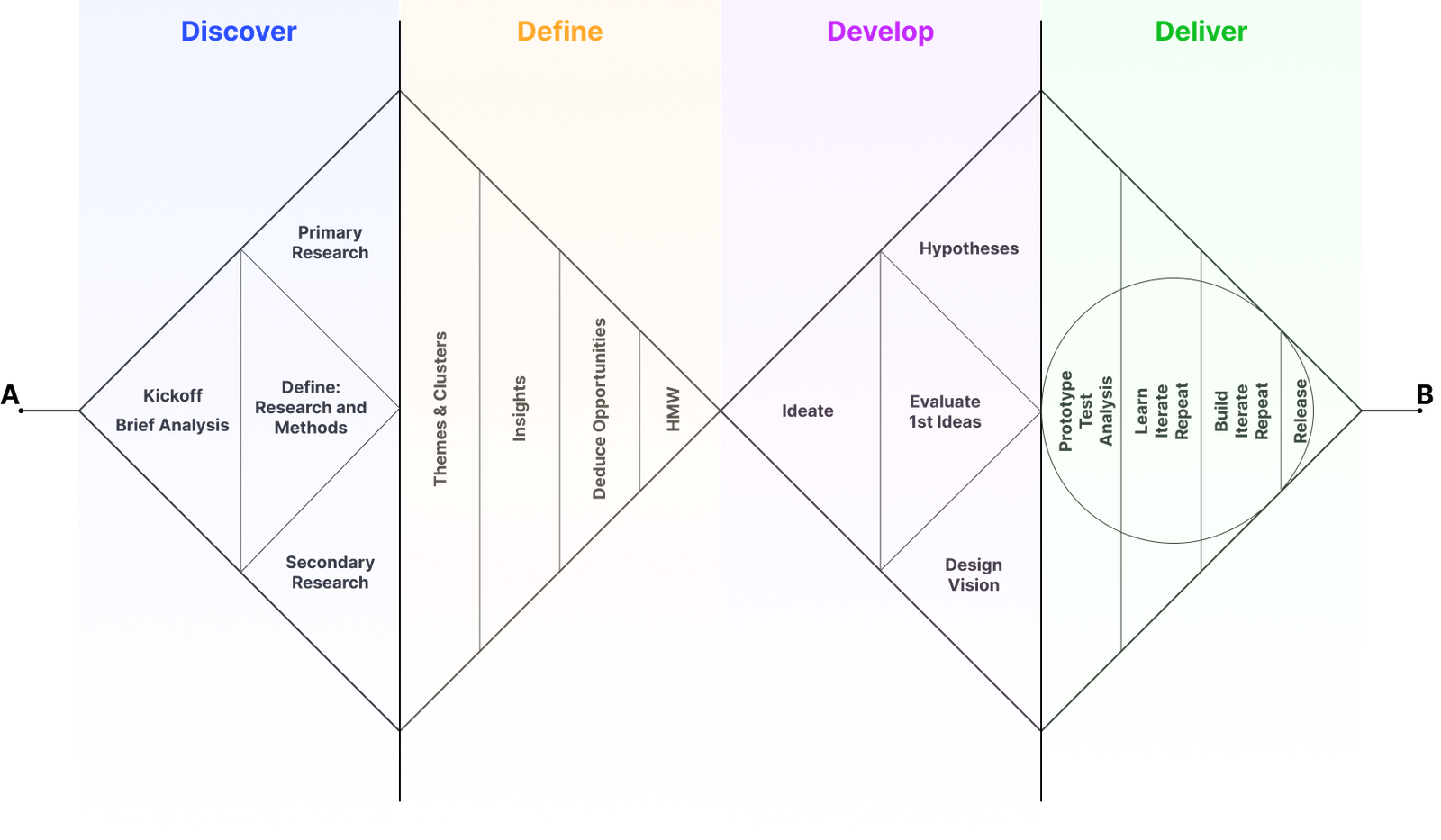
Design Process
Design Thinking
CSD Matrix
After reading the brief and documents provided by the cliente, I like to facilitate a CSD worshop to bring everyone to the same page.
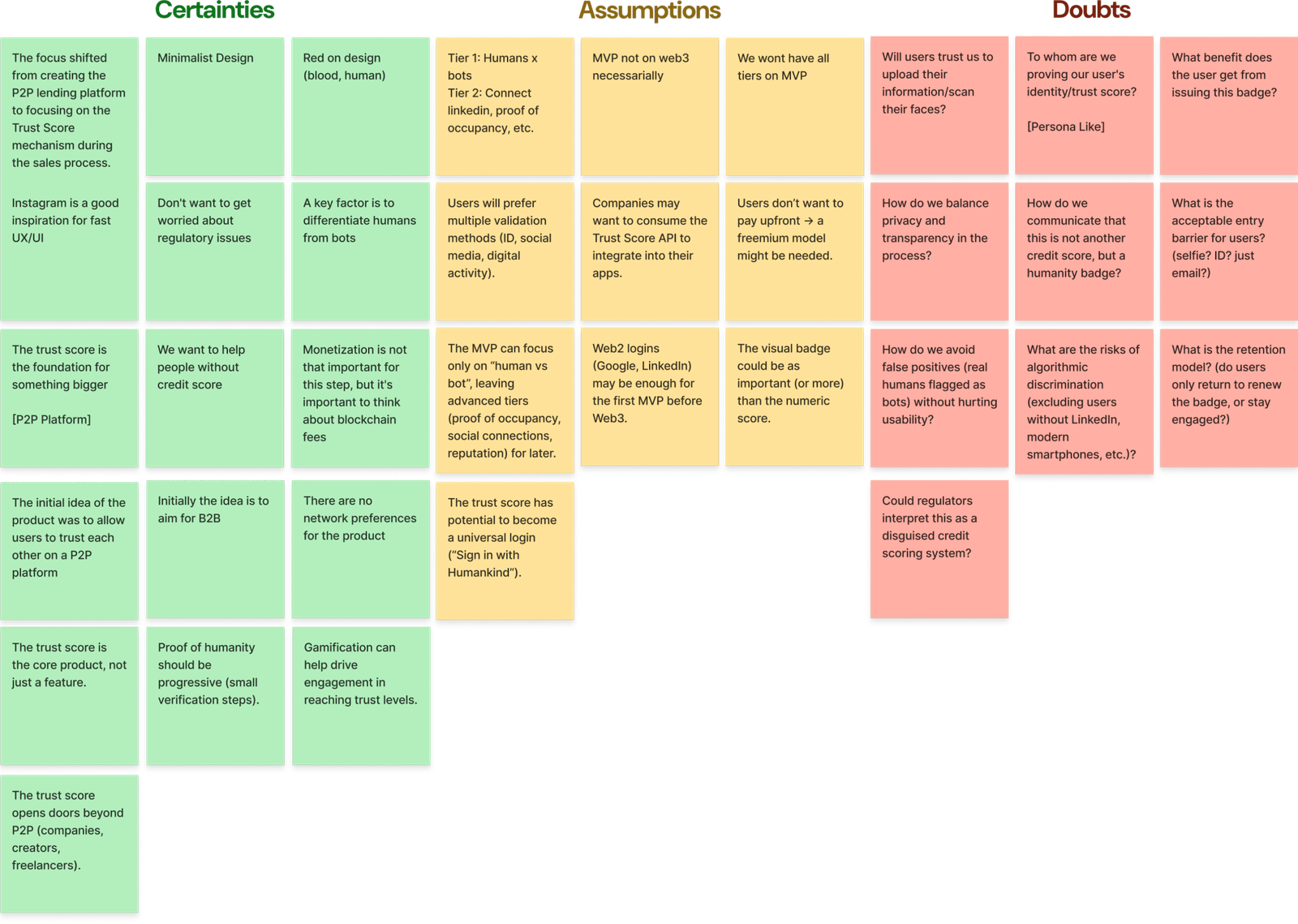
CSD Highlights
Certainties
Trust Score is the core product.
MVP is human vs bots.
UX must be fast, simple, trustworthy.
Assumptions
Start with Web2 logins (Google/LinkedIn).
Badge = more valuable than numeric score.
Expand later into tiers & integrations.
Doubts
Will users trust the process (privacy, data)?
What’s the clear benefit of having the badge?
How to ensure fairness & inclusion?
Research
Primary, secondary, quantitative and qualitative
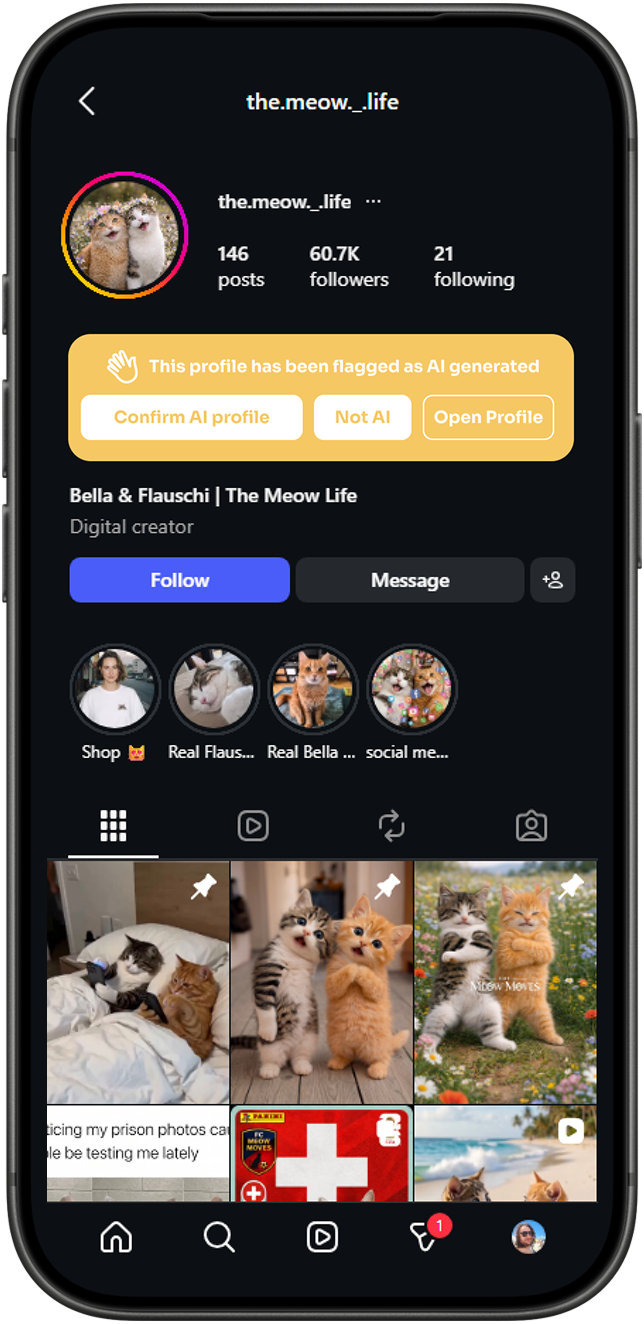
User Story
“I want to be able to check if a content is AI”
Secondary Research
Competitive Analysis
Who makes something similar already?
 |
 |
 |
 |
 |
 |
 |
 |
 |
 |
 |
|
|---|---|---|---|---|---|---|---|---|---|---|---|
| Core Focus | Sybil resistance & identity for Web3 | Global unique identity via biometrics | Biometric-based decentralized identity | Identity and data security | AI-driven identity verification | Digital identity wallet | Decentralized identity layer using palm biometrics and zk-proofs | Credibility ratings for news and information | Digital ID Platform, mobile wallet, age check. | End-to-end customer identity verification | Open on-chain registry that verifies real humans. |
| Similarity | ~99% | ~90% | ~90% | ~30% | ~40% | ~50% | ~70% | ~10% | ~50% | ~40% | ~70% |
| Target | B2C/B2B | B2C/B2B | B2C/B2B | B2B | B2B | B2B2C/B2G | B2B (Web3) | B2B/B2C | B2B/B2C | B2B | B2B/B2C |
| Biometric Requirement | Optional (via Human ID partner) | Mandatory (iris scan required) | Mandatory (palm scan via phone) | Facial and documents | Selfie (with AI), documents | Selfie, documents | Hand palm, ZKP | None, auditorial only | Facial, selfie, age | Facial with AI, video, documents, continuous checks. | Selfie with video, ETH deposit. |
| Monetization | Open infra (Holonym ecosystem) | Token-based (WLD), app ecosystem | Likely token-based + SDK usage | License / SaaS | Subscription | Government Contracts, API licensing | Token usage fees | Subscription | B2B verifications | Based on verification volume (B2B) | Gas (ETH) |
| Strengths | Legacy Gitcoin trust, privacy, flexibility | Funding, scale, media presence | Innovative biometric UX, zkLogin | Broad portfolio, compliance suite, strong brand | High accuracy and speed, advanced fraud detection | 50M user base, ties to US gov, cross-sector network | Strong backing (Animica, Polygon) advanced security (IR, ZK proofs) | Niche expertise, widely cited by regulators and platforms | Privacy-first design, focus on age-verification, well-fundedn (over £160M) | Mature product, enphasis on continuos identity intelligence | Fully decentralized, censorship-resistant, integrated into web3 governance |
| Opportunities | Leverage network, partnership with web2/web3 platforms | Large adoption via free orb verifications | Cutting-edge tech that atracts web3 interest, institutional backing (Polygon Animoca) | Takes advantege on KYC/AML demands and regulamentations | Takes advantage on deepfakes, frauds and scams that increased by 700% in 2024 | Big network, gov regulamentations. | New pattern to stop frauds and bots, integration on fintechs. | Fake news and fact checking need is increasing | New laws of age verification, big partnerships | Increased demand of KYC/AML | The need of increasing of identity importance on web3 |
| Weaknesses | Trust depends on issuer integrations | Privacy controversy, ha rdware friction | Early stage, not widely adopted yet | Enterprise focus may be heavy/expensive | Competition with many IDV providers | Controversies over privacy and mandatory use by state agencies | Still in testnet, hardware need, faces competition | Limited overlap with personal identity/trust use cases, faces criticism on bias | Struggles to monetize consumer side | Competes in crowded market | Low mainstream awareness; manual submission process, small user base |
| Threats | High user friction for biometric checks, privacy concerns, competition | Requires the Orb (hardware) limiting reach, regulatory/legal scrutinity | User adoption hurdles (hardware) niche positioning vs simpler solutions, unknow compliance for biometrics | Big competition | Global competition | Privacy critcism, controversy history, public trust decreasing on them. | Hardware adoption need | Susceptibility to biased criticism | Competitive pression from digital ID from big techs | Deepfakes can reduce effectiveness | Governance, cost of use, competition |
Competitors Insights
The market is split between compliance and ideology with a gap between them

Web2 Players
Built for business (B2B, B2G)
- KYC
- Fraud Prevention
- Regulatory compliance
- API First (not user-first)

HumanKind
GAP
- Trust without compliance
- Avoids ideological complexity
- Low friction
- Allow users to opt into stronger tiers when needed

Web3 Players
Technical Complexity
- Decentralization
- Identity ownership
- Sybil resistance
- Tied to crypto ecosystems
High-trust methods create high friction
Examples: Iris scan, palm scan, In-person validations...
Primary Research
Collecting Data Ourselves
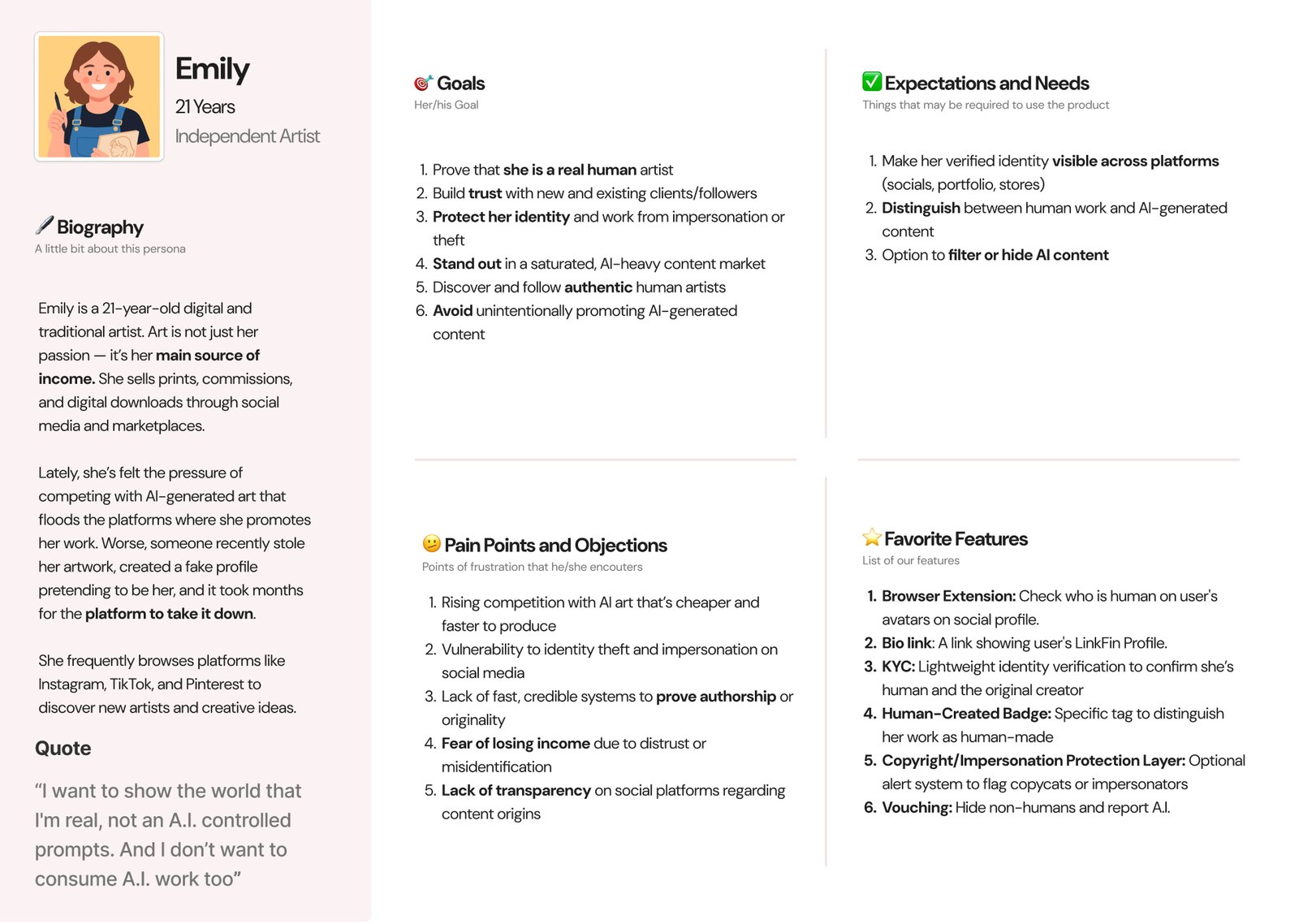
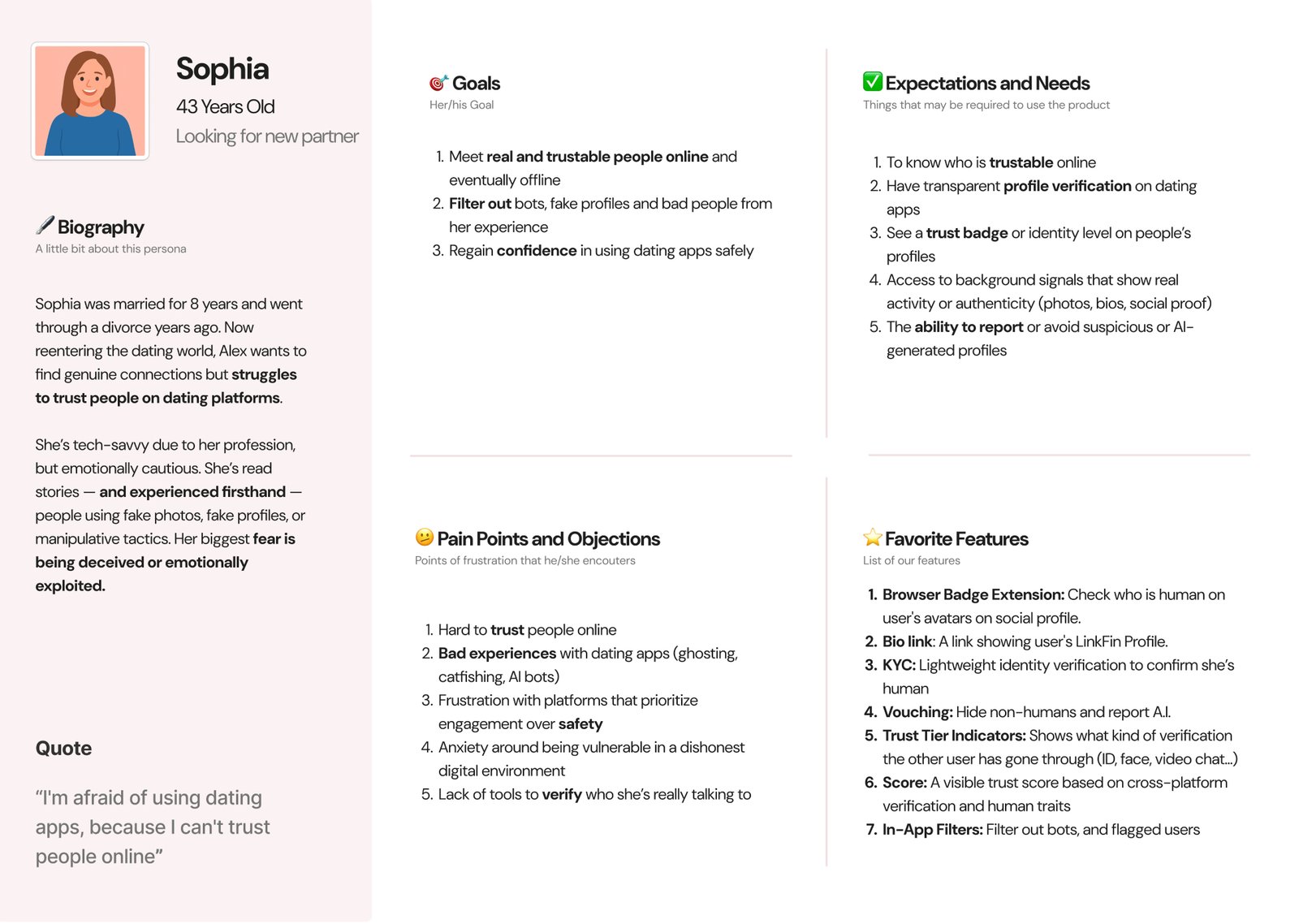
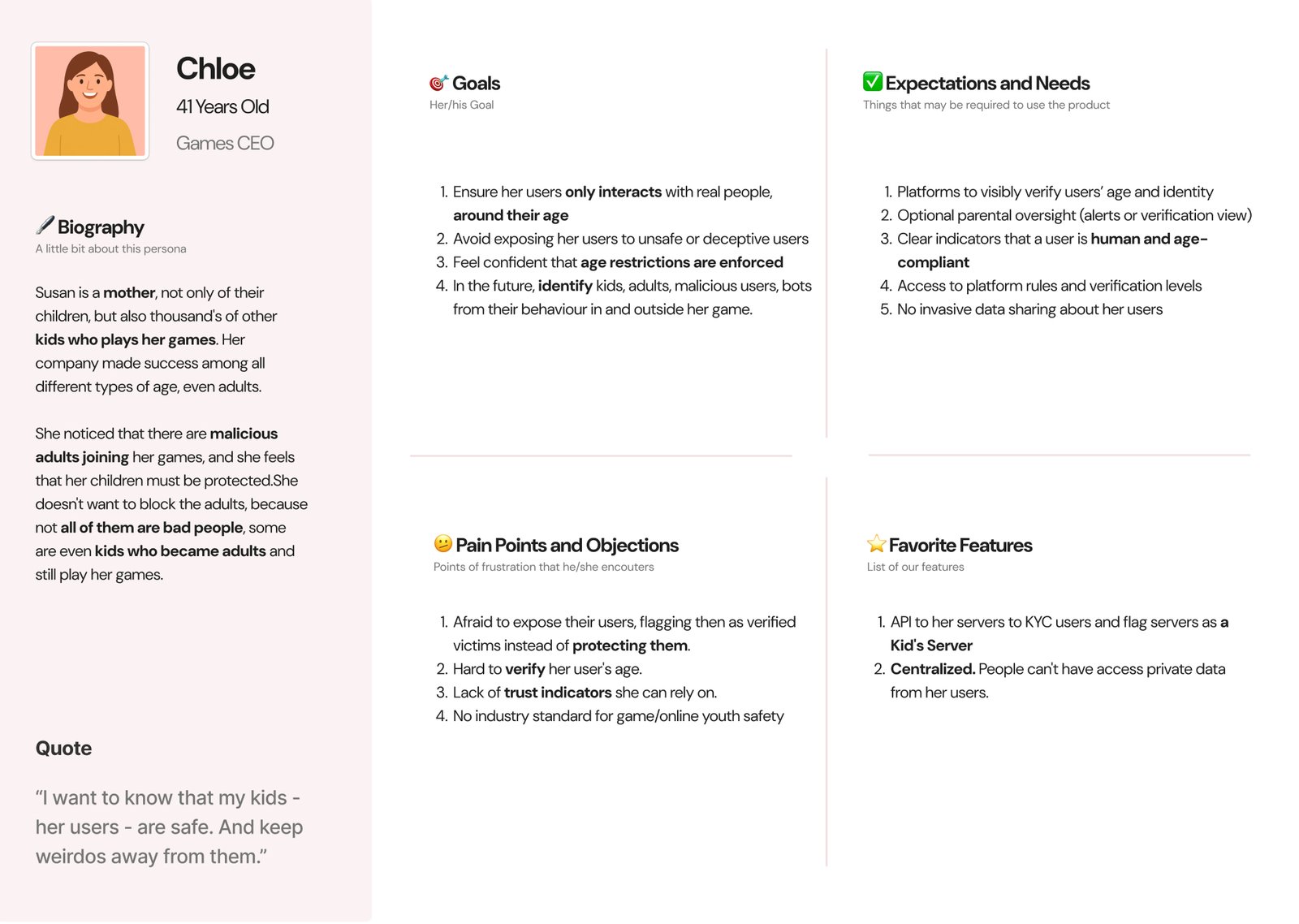
Proto-Personas
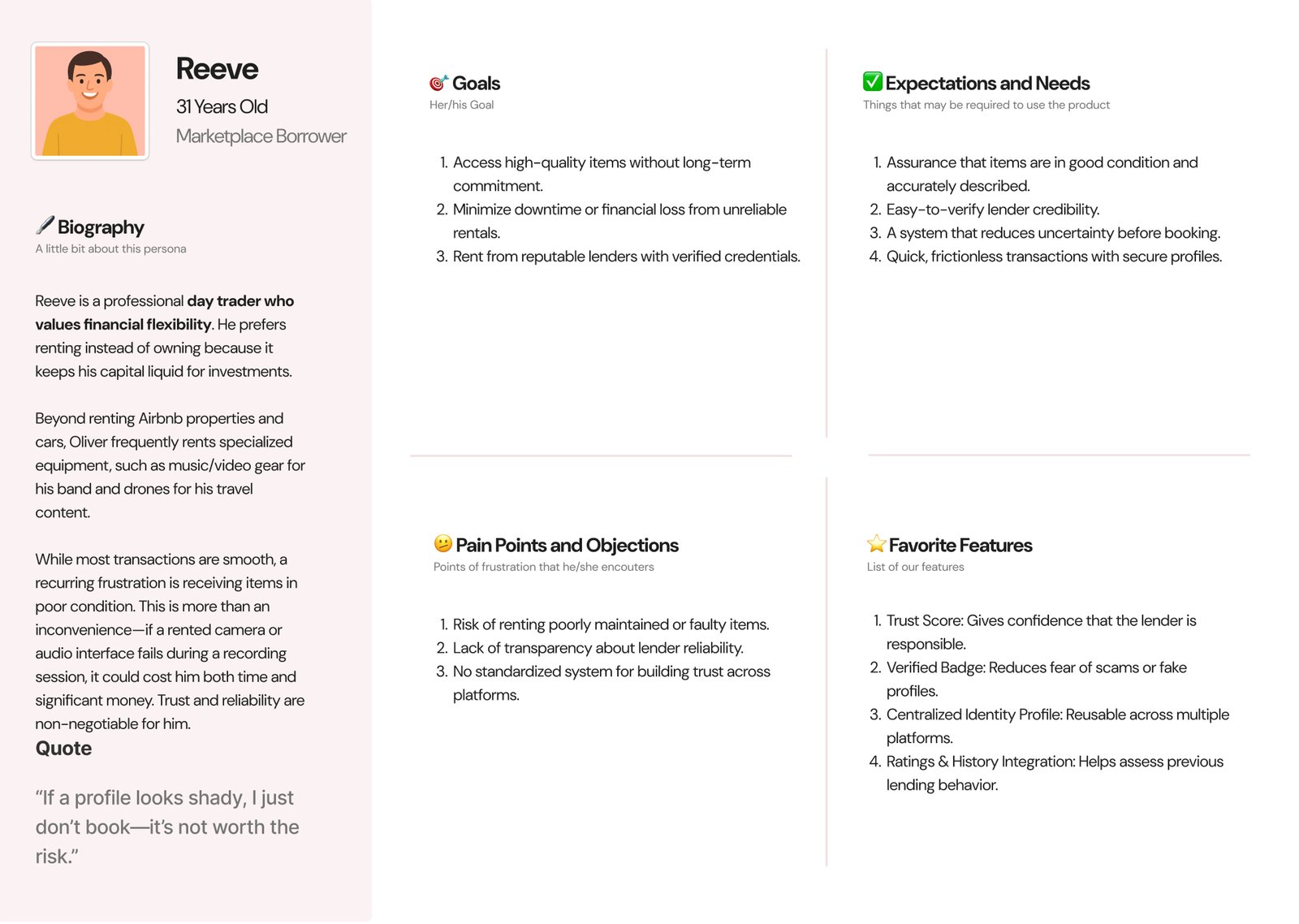
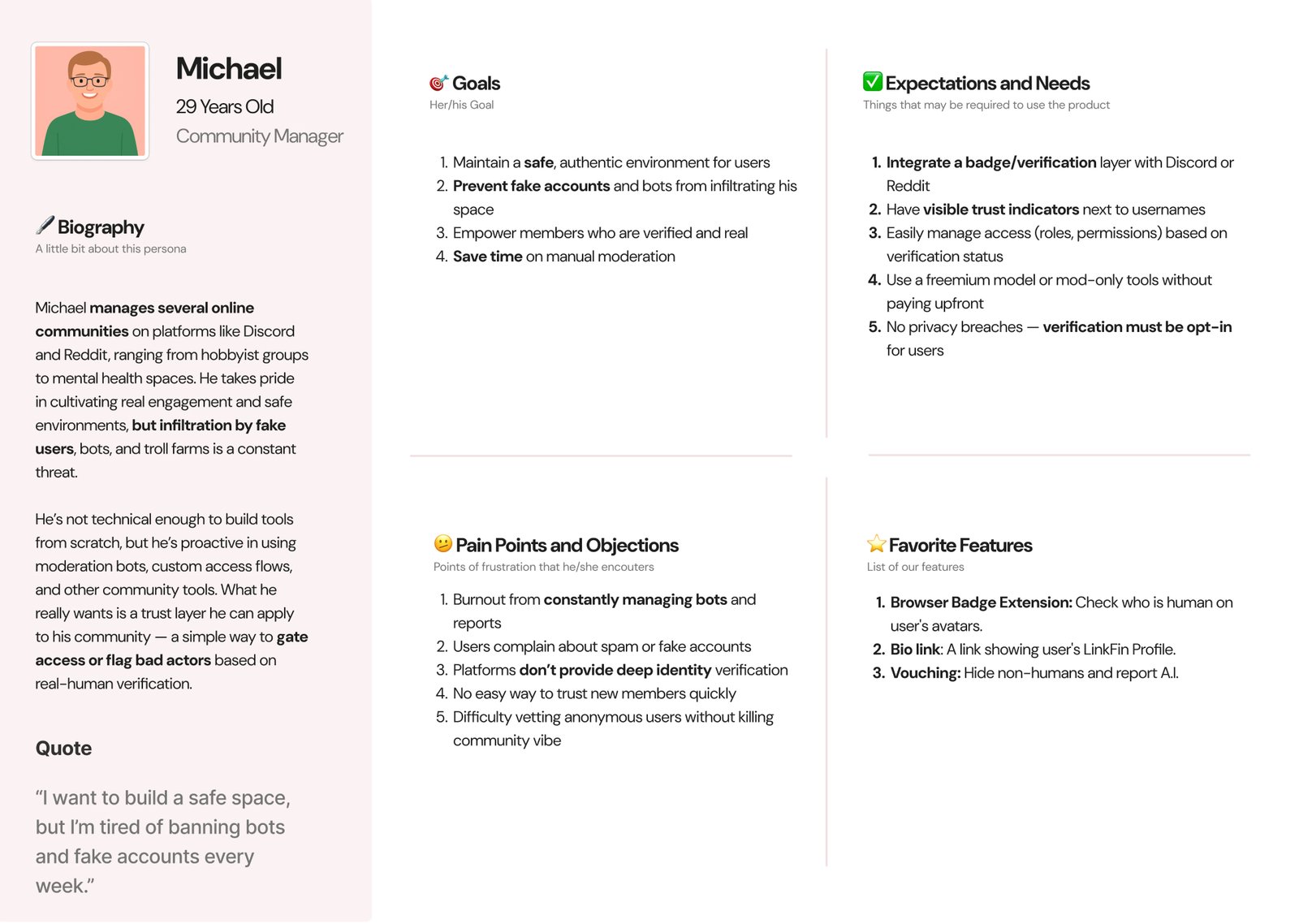
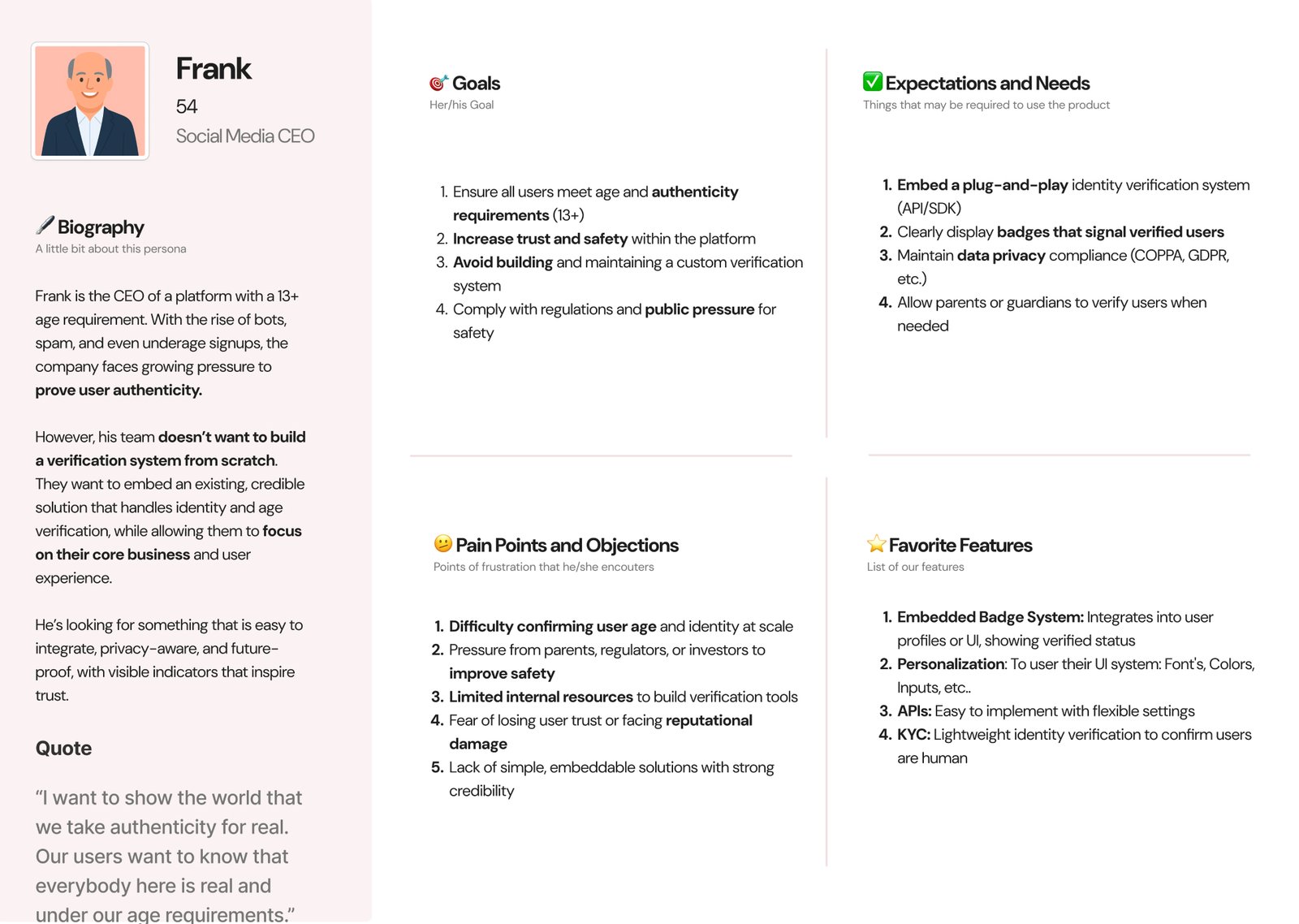
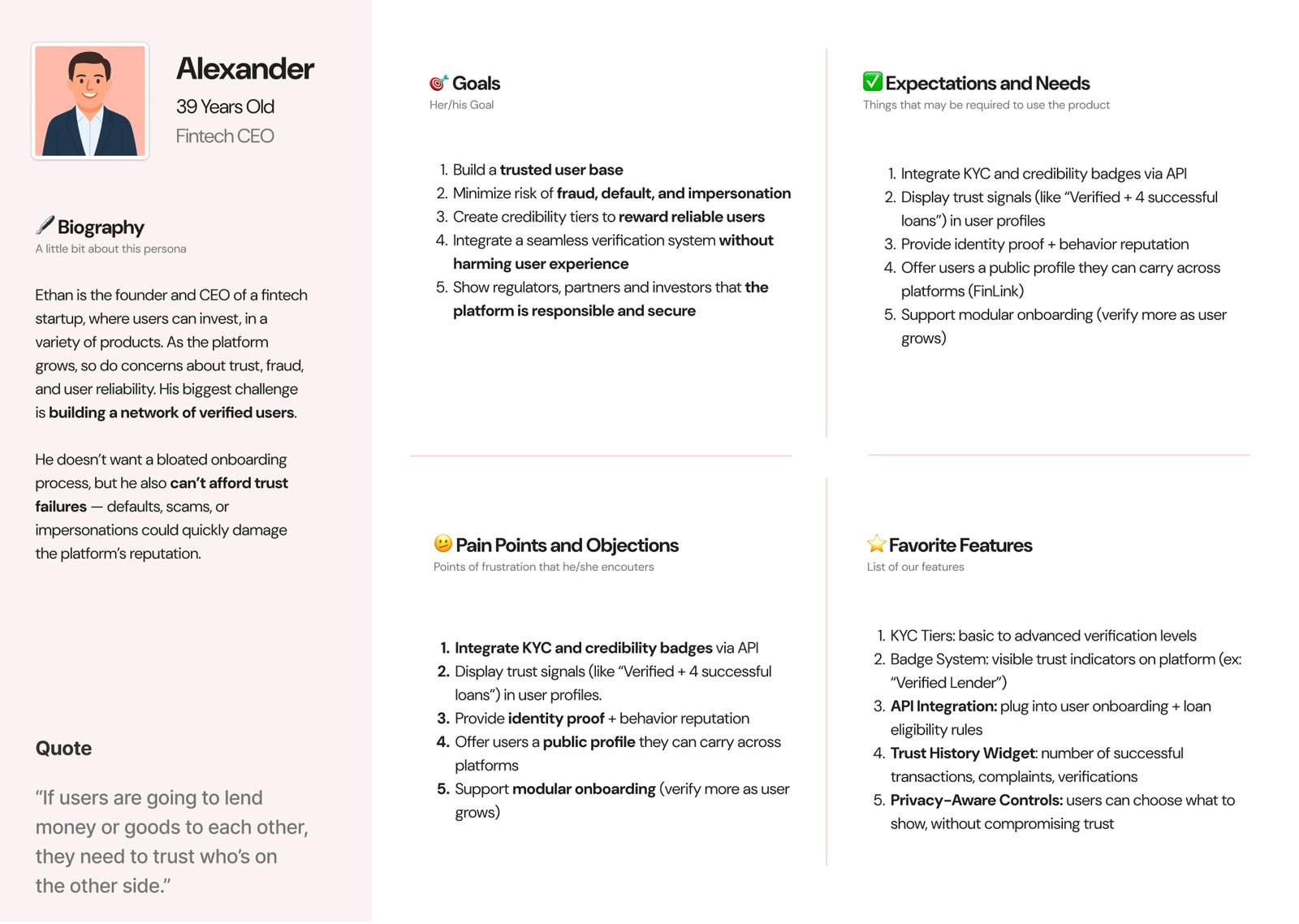
Based on the target, we created 11 proto-personas. - Proto-personas are personas before research. You will see that later on they will be down-sized and become personas.

Emily
Artist

Sophia
Dating Apps user

Olivia
Journalist

Ava
Lender

James
HR Manager

Daniel
News Reader

Reeve
Borrower

Michael
Community Manager

Frank
Social Media CEO
B2C

Alexander
Fintech CEO
B2C

Chloe
Games CEO
B2C
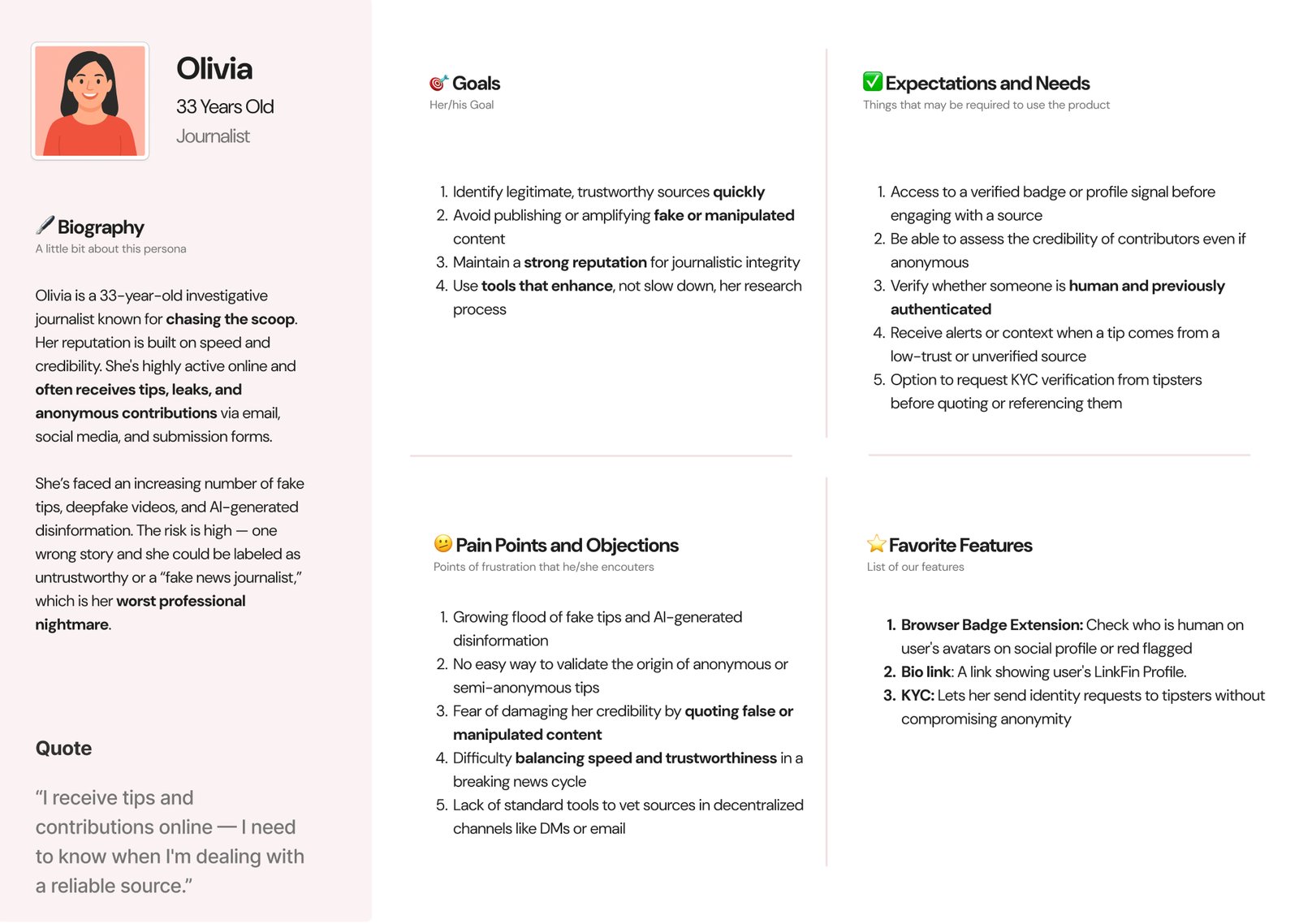
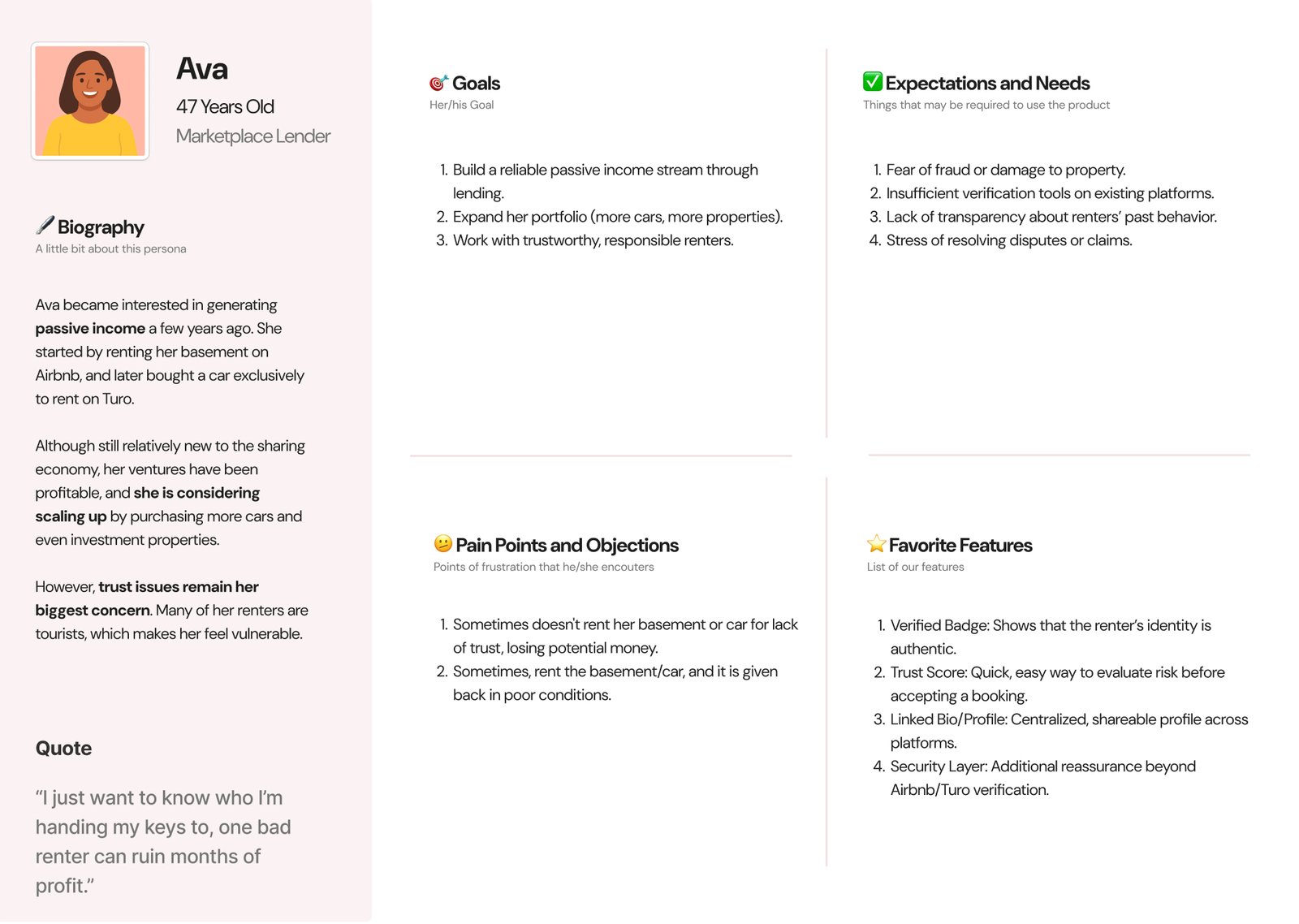
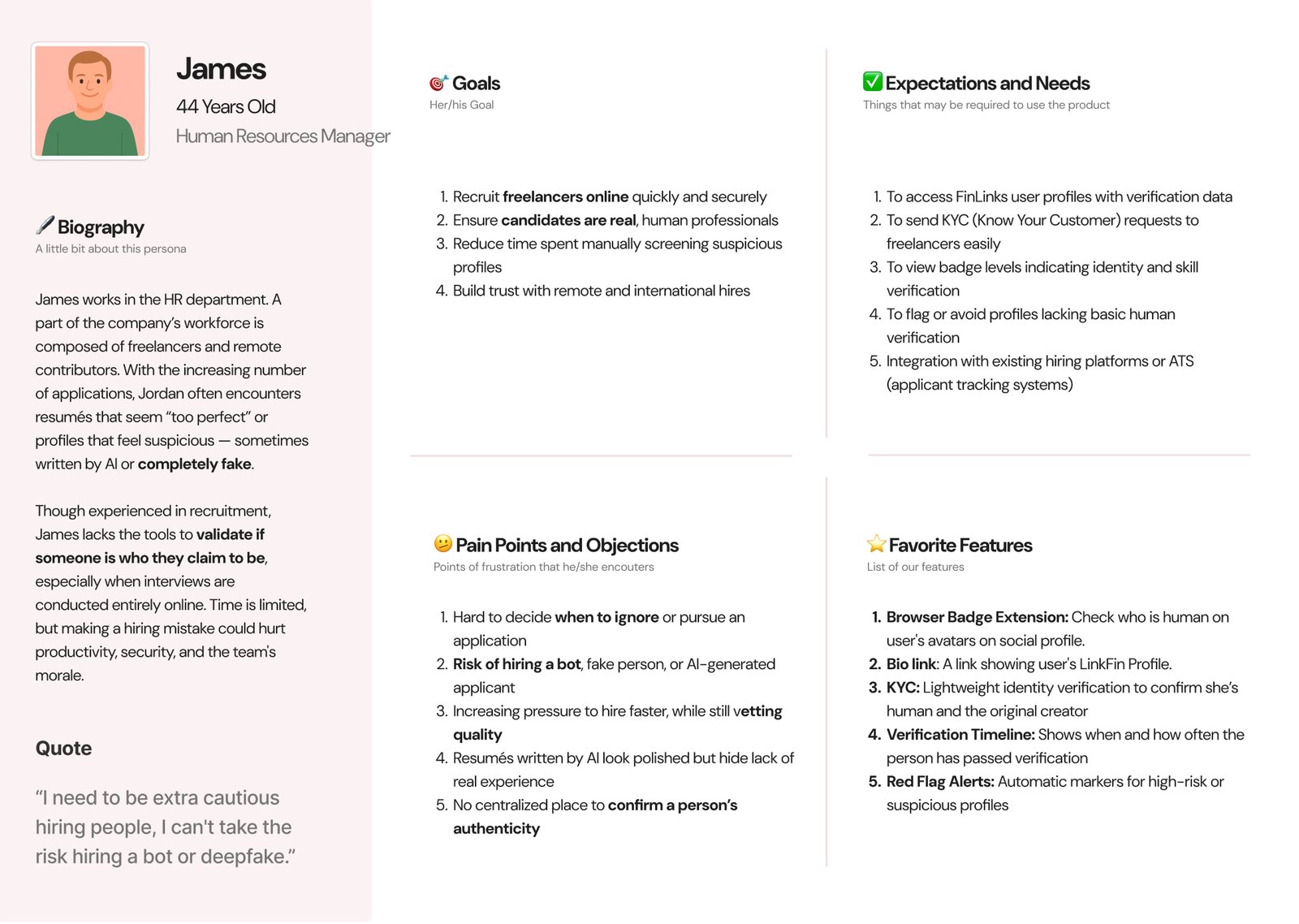
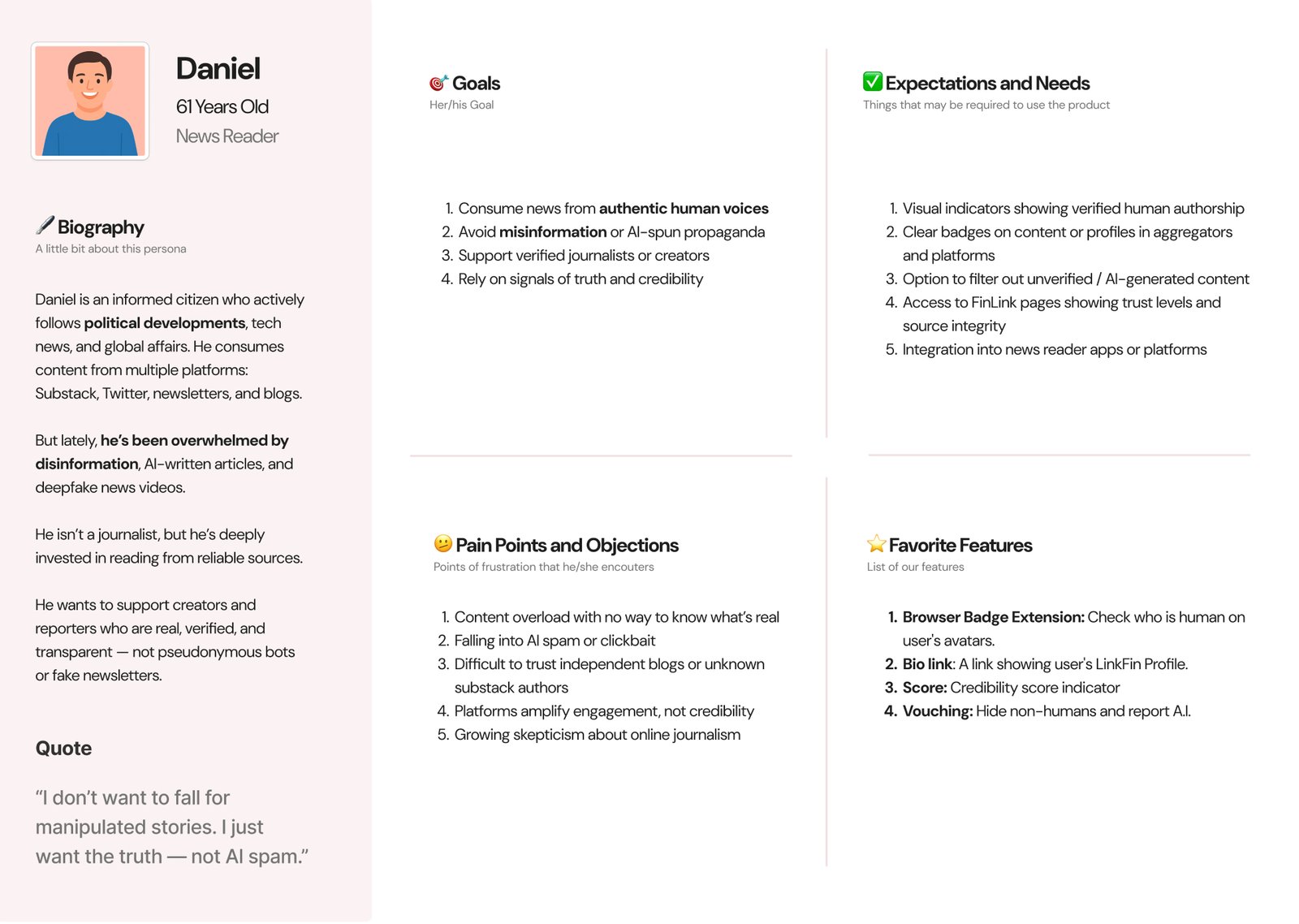
Survey
Overall Objective and Goals
Measure problem perception
Validate real impact (pain level)
Map priority use cases
Evaluate openness to a solution
Identify adoption barriers
Survey and Results
1. Have you ever had trouble figuring out if someone online was real or fake?
2. Have you ever had a bad experience with fake profiles, bots or deepfakes?
3. In which situation(s) are you most worried about fake profiles?
4. If there was a "Verification Badge" proving a user is real, you would:
Survey Inisghts
Identity uncertainty is widespread, but not equally urgent
Trust is not a constant need - it spikes in high-risk interactions.

Follow Up Survey
Overall Objective and Goals
Check acceptable proof methods
Understand if decentralization increases trust
Assess product fit in users’ lives
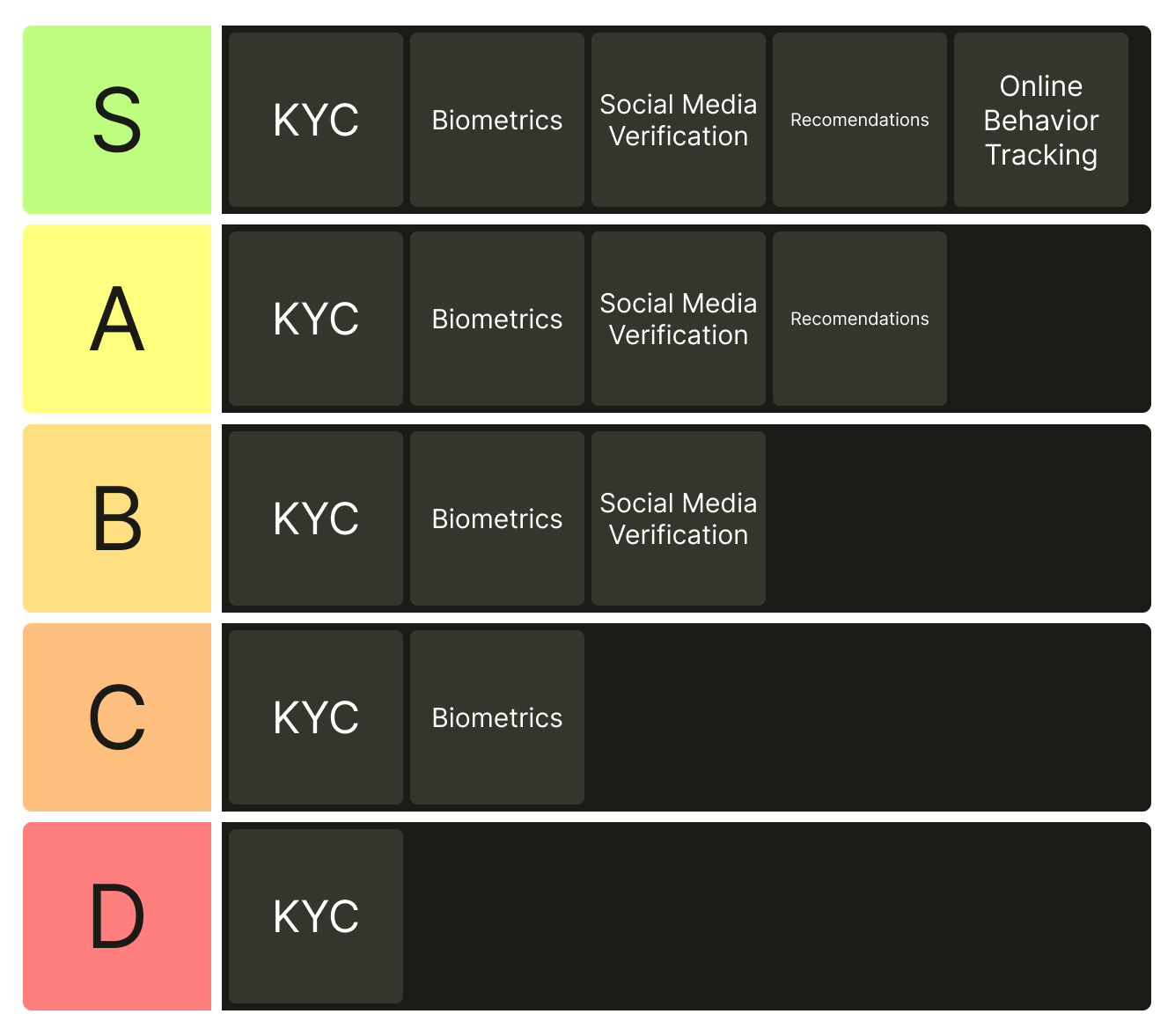
Identify most impactful trust signals
Monetization Viability
Survey and Results
1. Which verification methods would you be comfortable with to receive a “Verified Badge” (with access to higher trust tiers)?
2. Imagine your data is stored securely so that no single company or server owns or controls it, and only you have access to it. Would that make you feel more comfortable sharing your data?
3. Where would you like to use or check this badge?
4. What would make you trust an online profile the most?
5. Would you pay to get verified in a higher tier level?
6. Would you pay to be able to check if other users are real?
Follow Up Insights
Trust signals are fragmented - no single indicator dominates
The product must act as a trust aggregator, not a binary validator.

User prefer low-friction, low-exposure verification methods
Offer tiered verification levels, and reward the most friction ones.
User Interviews
Highlights
We selected a few users to talk with about their experience with fake profiles and online interactions.
Bellow you can check the inteview quotes highlights.

"That is literally the whole idea behind the Turing Test. Good luck. You'll need it."
"I worry about having to verify my identity with my ID that has my home address, since I am on political asylum in another country I do not give that piece of info so easily and I do not own land to be on public record. A data leak would be my main concern."
"I’m not sure how this would work or in what context. Sorry but this is an interesting idea that will probably have not a lot of practical value"
"You’ll also run into tradeoffs between privacy, friction, and enforcement. Browser extension means distribution friction. API means platform dependency. Neither solves the core trust UX unless your proof holds up against synthetic actors at scale."
"One thing to consider with calling something "human verified" is whether that indicates it was simply fact checked by a human or the information was obtained by a human. Given how frequently humans are tricked by LLM inaccuracies and how LLMs leave out crucial information, I don't trust information just because a human fact checked the LLM's sentences."
"The real unlock won’t be proving someone’s human, it’ll be aligning that proof to risk-adjusted contexts."
"In payments or compliance, “verified human” doesn’t mean much without continuous identity binding. Meanwhile in social or reputation apps, you need lightweight but credible heuristics, not full KYC."
User Interviews Insights
Lack of Understanding
"I don't really get it"
Value Proposition is unclear
Terminology creates confusion
The concepts feels abstract and distant
Lack of Trust
"I'm not confortable with this"
Privacy is a blocker, not a concern
Proving humanity feels invasive
Trust depends on context
Lack of Perceived Value
"Why should I use this?"
Not obvious benefits without context
Hard to relate to real-world use cases
Looks like a solution looking for a problem
Fragile Trust Model
"This won't hold over time"
Trust decays and evolves
One-time verification is not enough
Users expect continuous dynamic signals
Users don't reject the idea
They reject the current framing and execution
Product Directions:
Global trust score Contextual trust signals
Prove Humanity Reduce Risk
One-time verification Continuous trust
Opaque system User-controlled privacy
Cross-Research Synthesis
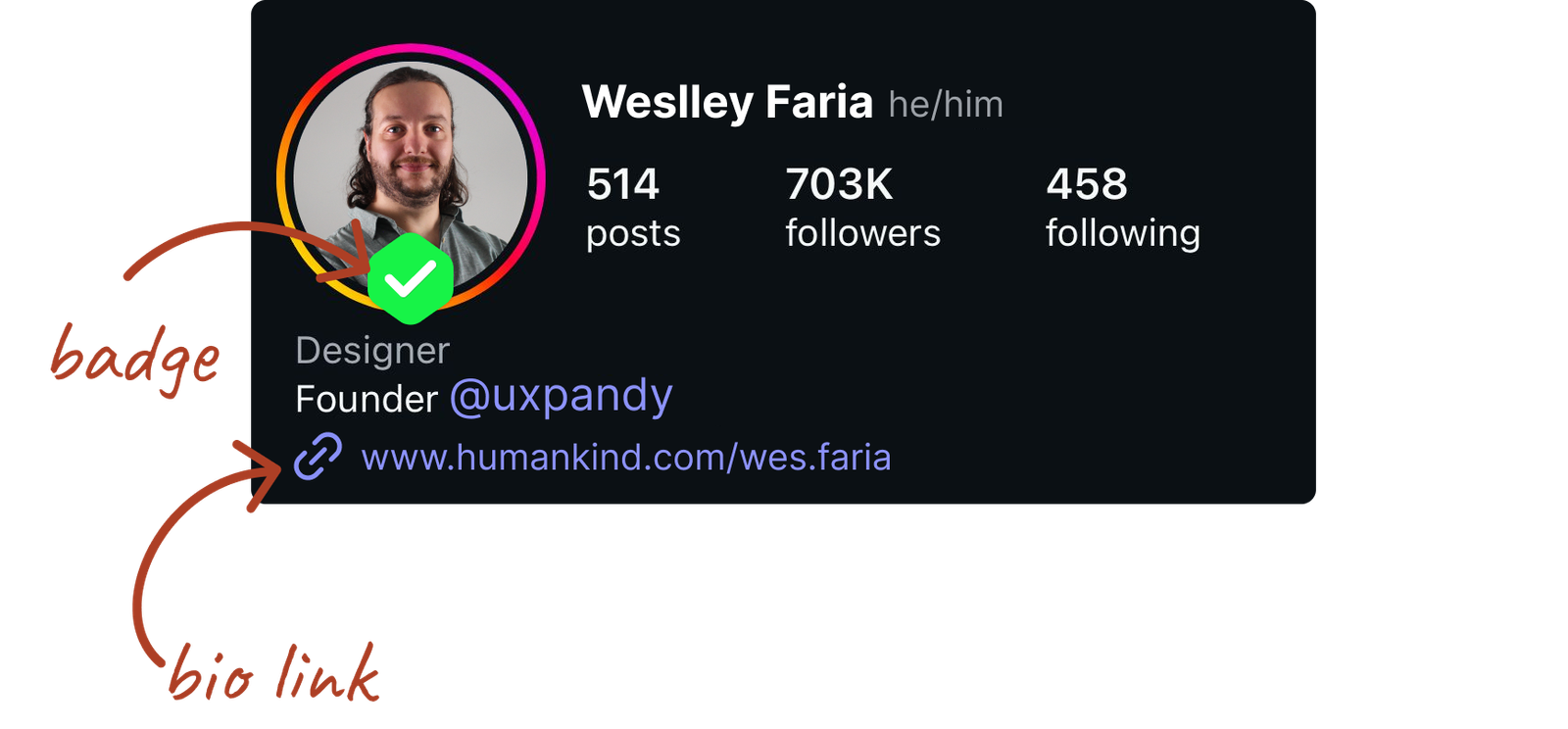
Usage is platform-driven, not product-driven
User's don't want a new platform, they want trust embedded into existing ecosystems.
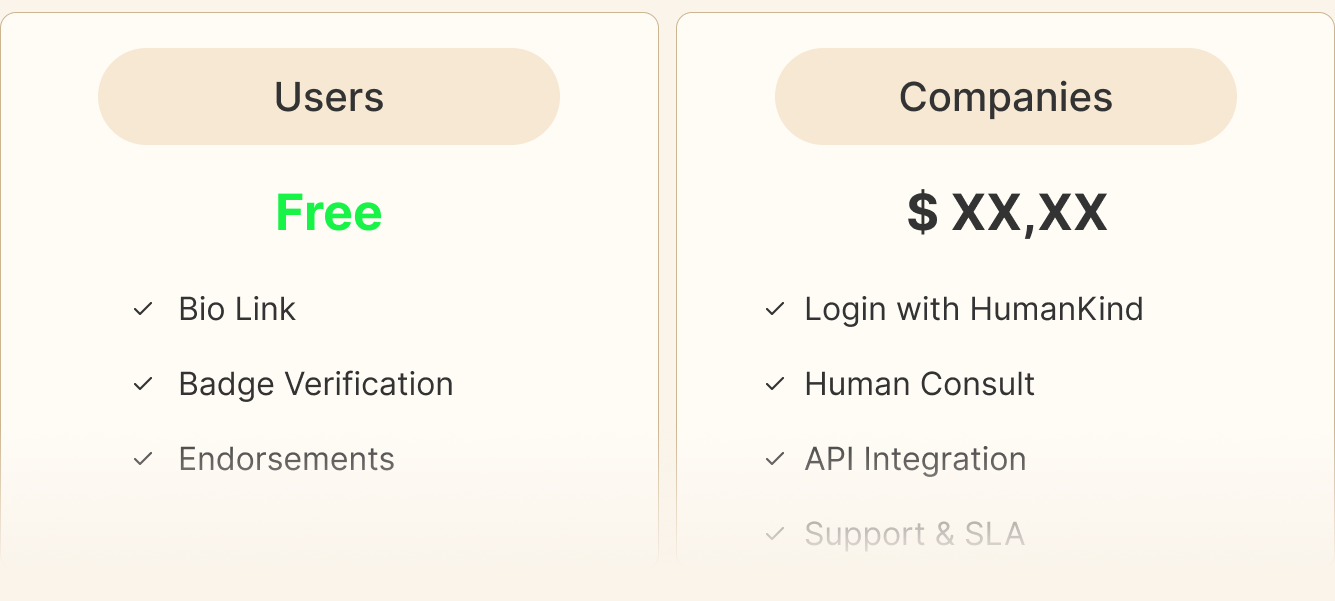
Monetization resistance is high on the consumer side
Trust is expected to be free infrastructure, like HTTPS. Monetization better on B2B (APIs).
Trust is a tradeoff - not a feature
Trust x Friction x Privacy
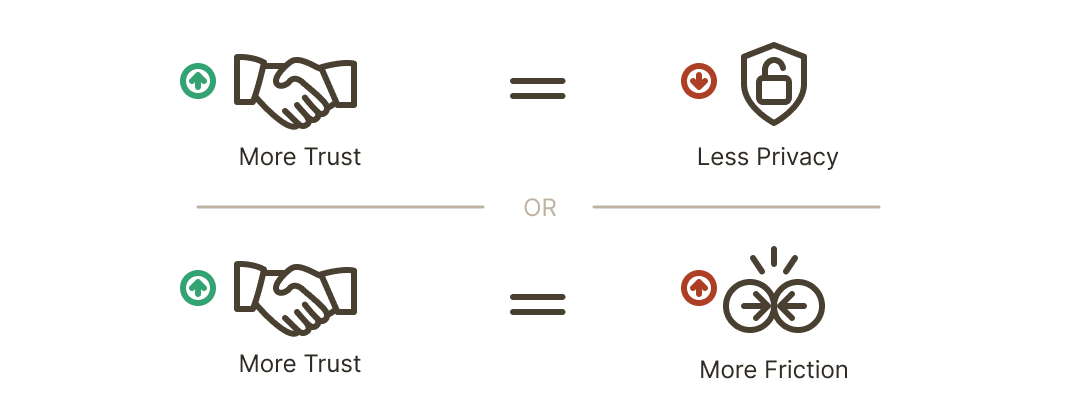
Users are aware of the tradeoff and they want to choose their balance.
The real job is not identity, it's confidence
User's are not asking:
"Who is this person?"
They are asking:
"Can I trust this interaction right now?"
Identity is not the goal. Confidence at the moment of decision is.
Users don't need a global identity systenm, they need fast, contextual answers:
"Can I trust this seller?"
"Is this person real?"
"Is this interaction safe?"
The opportunity
Build a lightweight, adaptative trust layer that:

Cross platform

Scales with context and risk

Balances trust, privacy, and friction
Similar to HTTPS:
invisible by default visible when it metters.
The idea is valuable, but fragile
and only works if positioned correctly
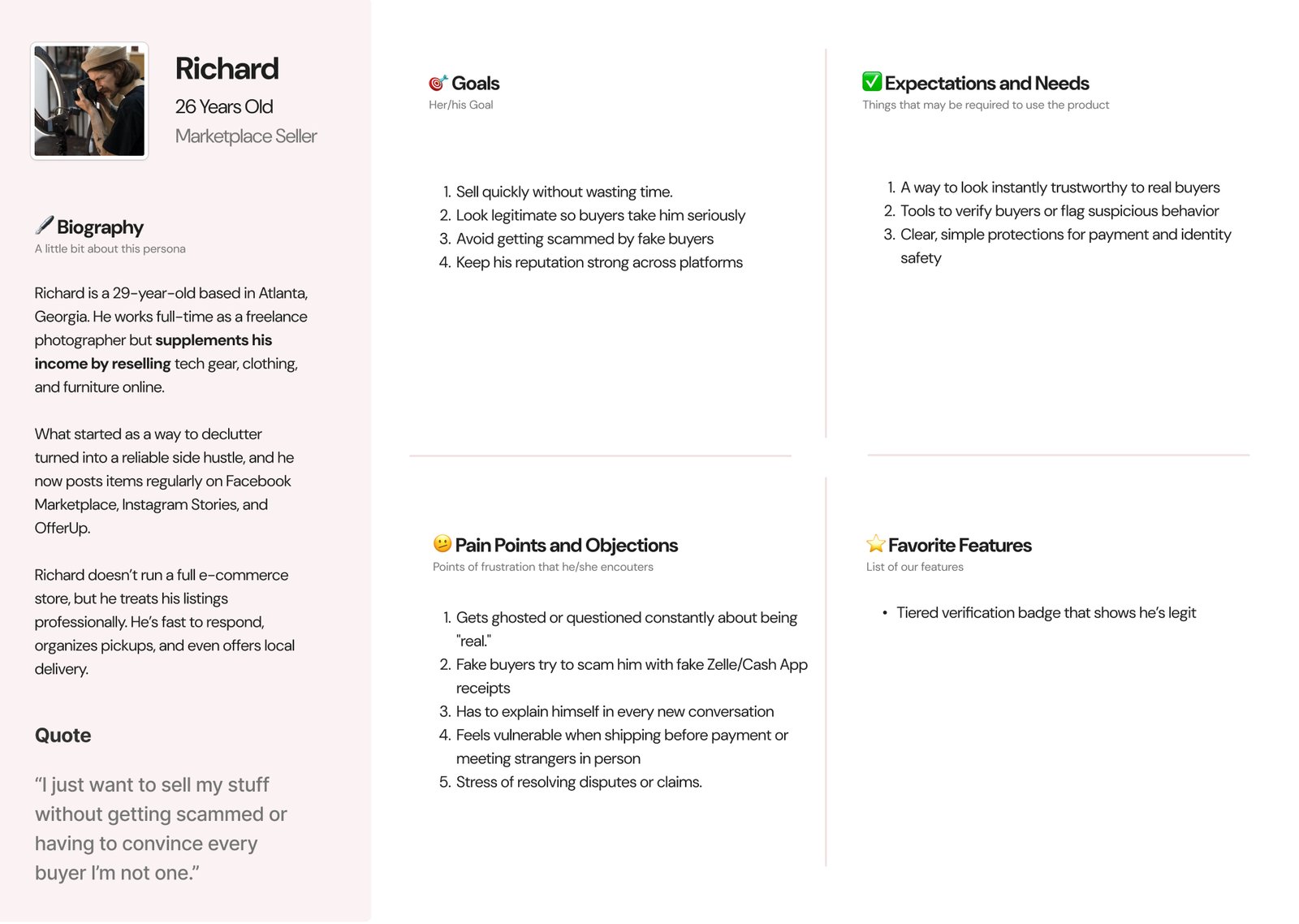
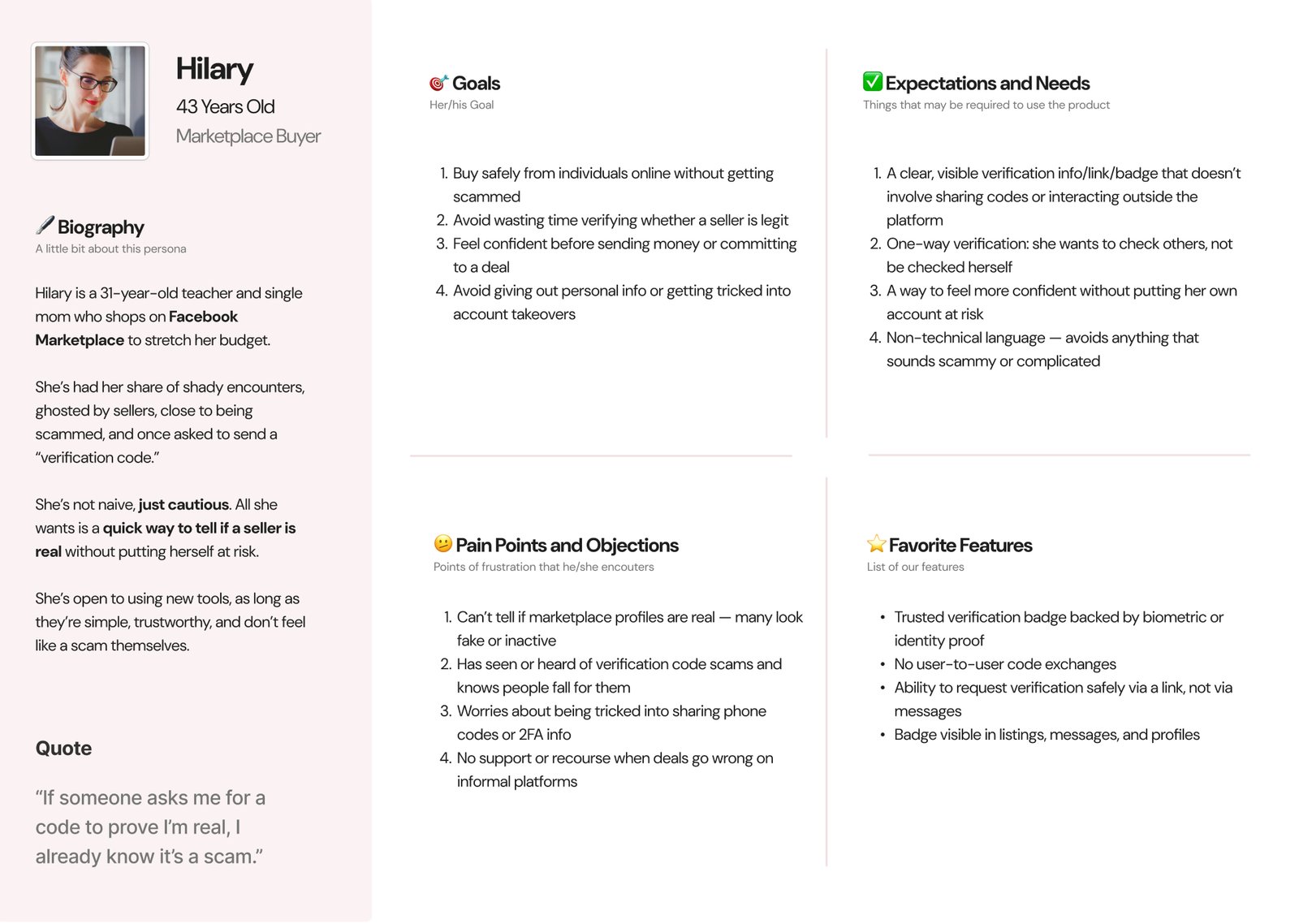
Personas
We downsized the 11 proto-personas to 2 personas:
User Story
“I want to be able to check if a content is AI”

Richard
Marketplace Seller

Hilary
Marketplace Buyer
Site Map
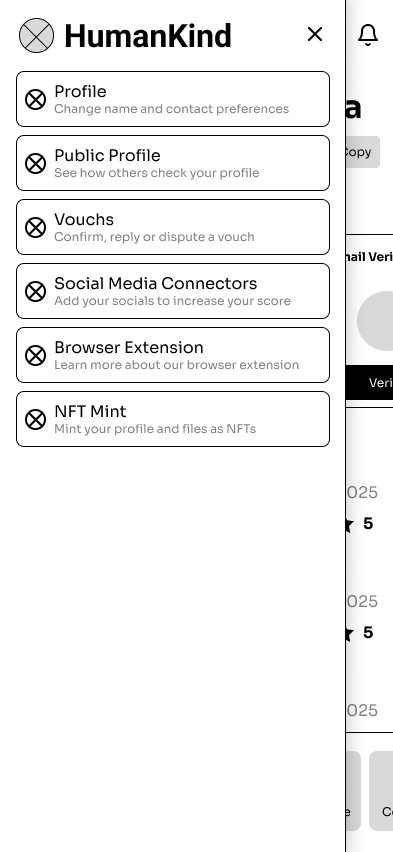
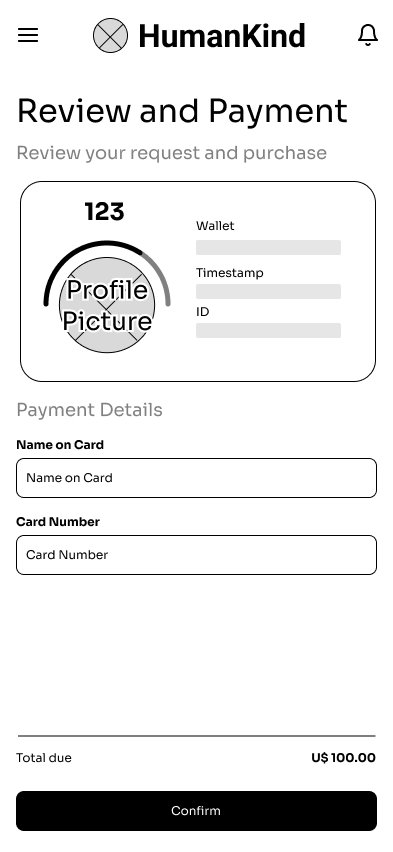
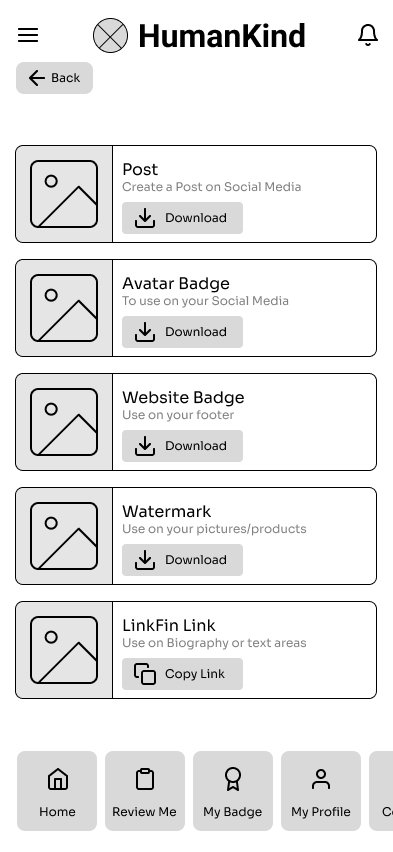
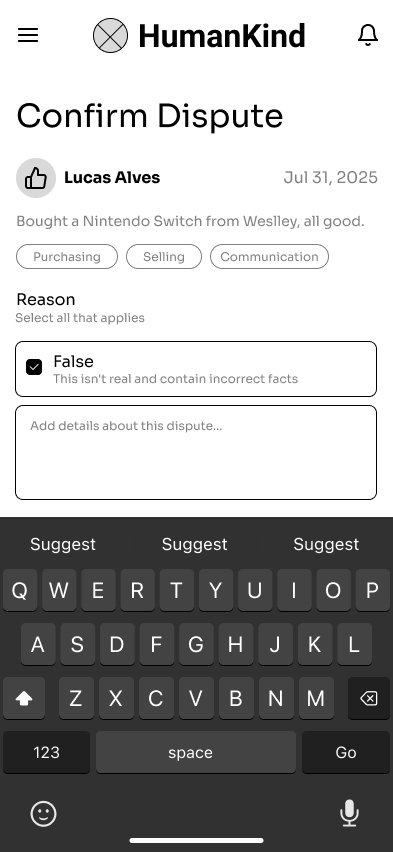
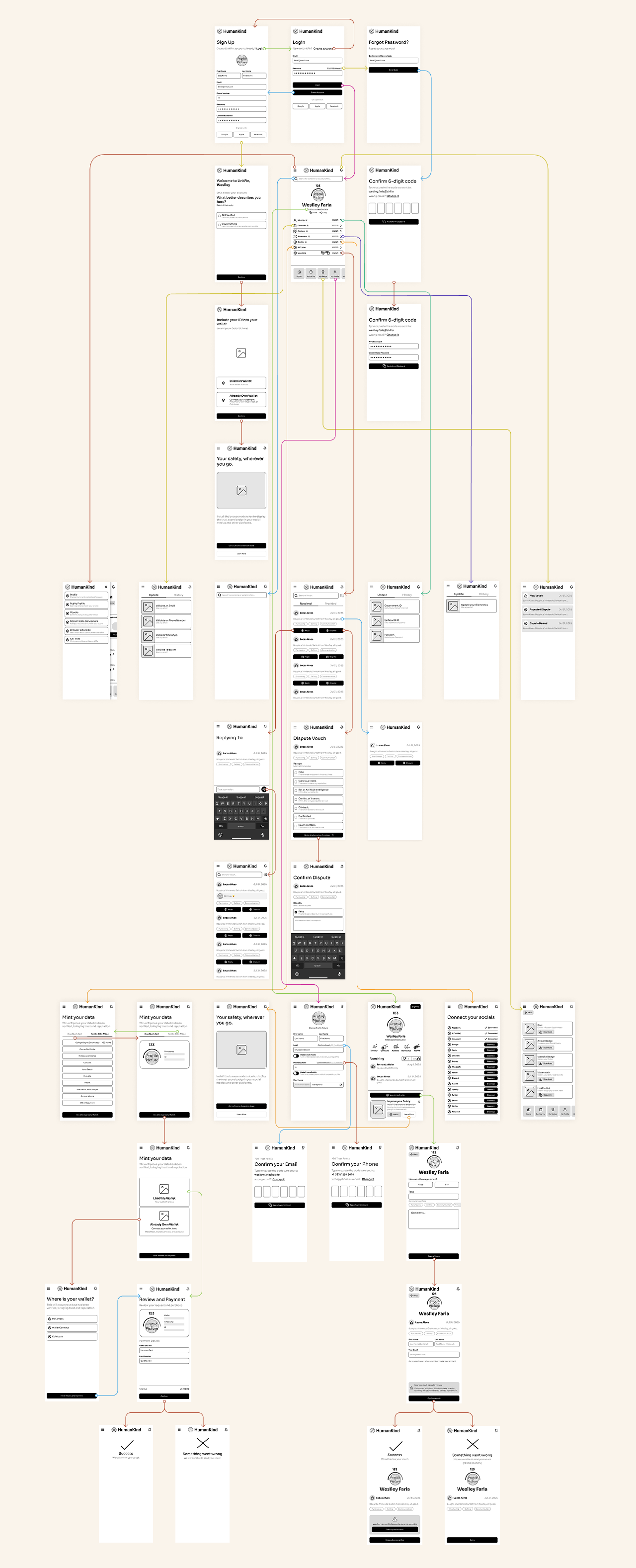
This helps me understand the user flows and all pages I will design
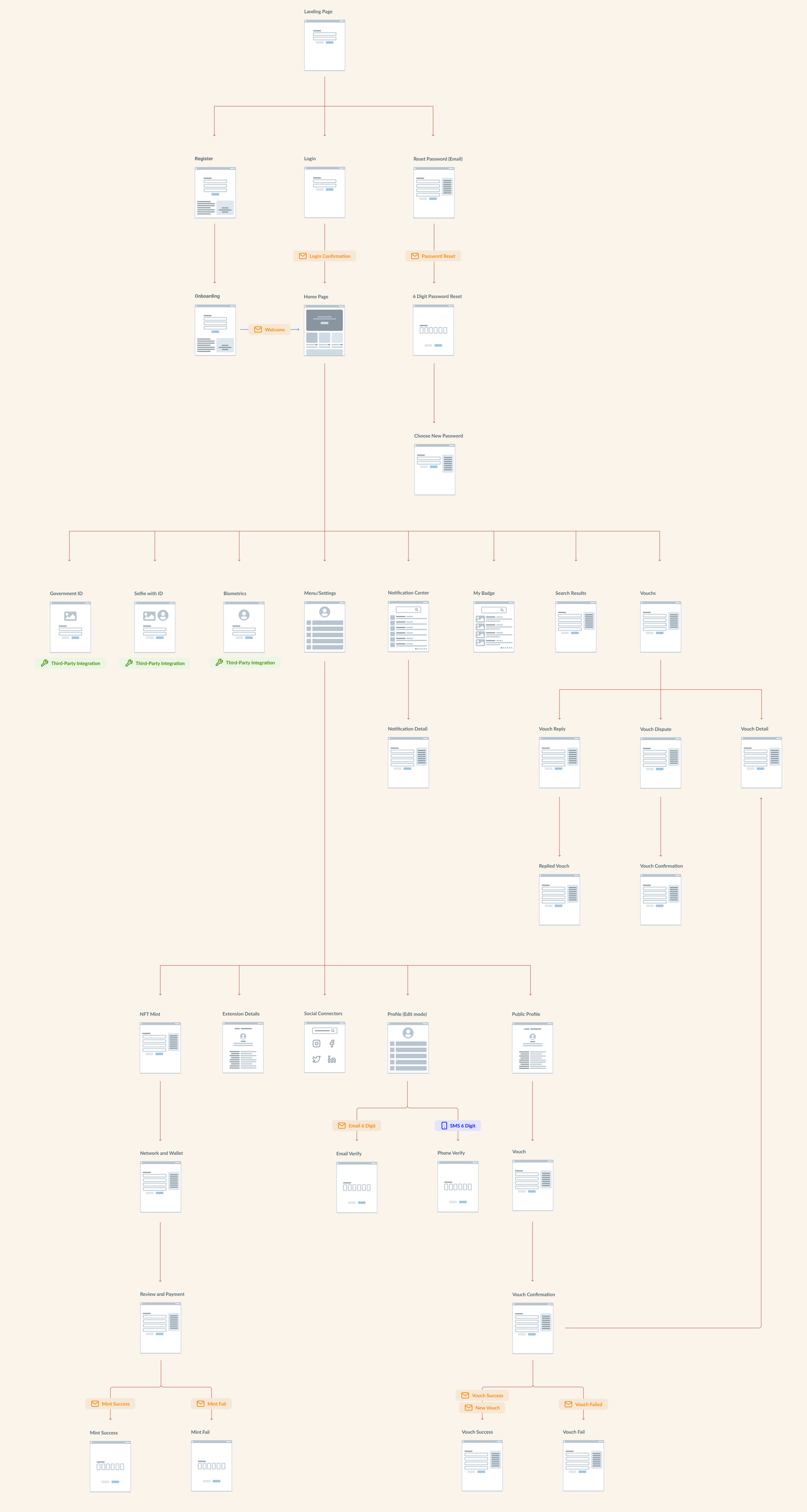
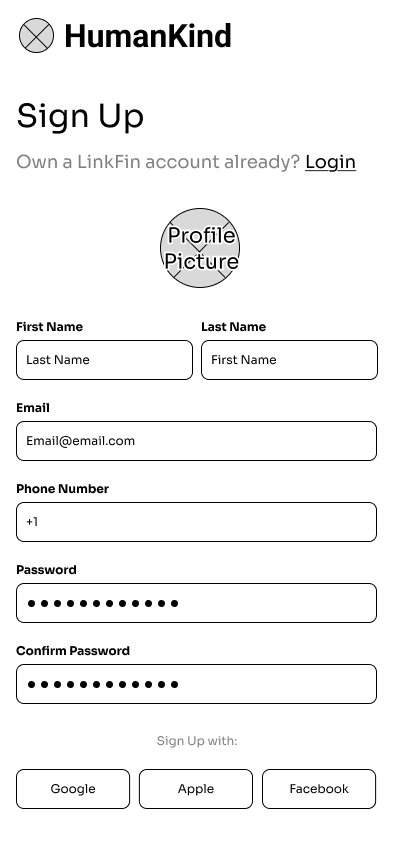
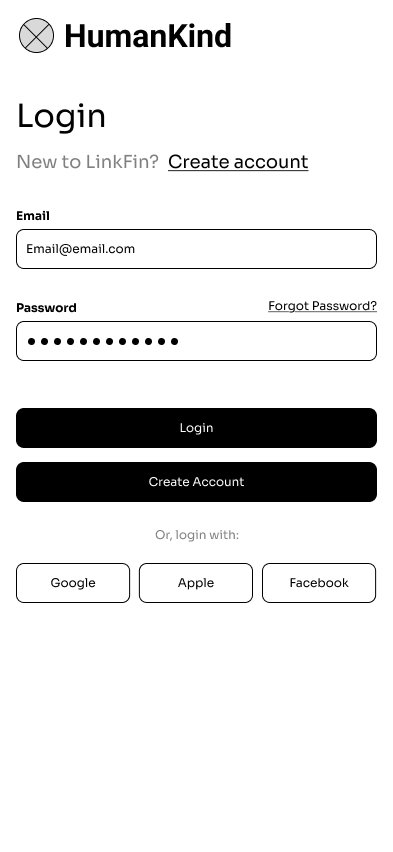
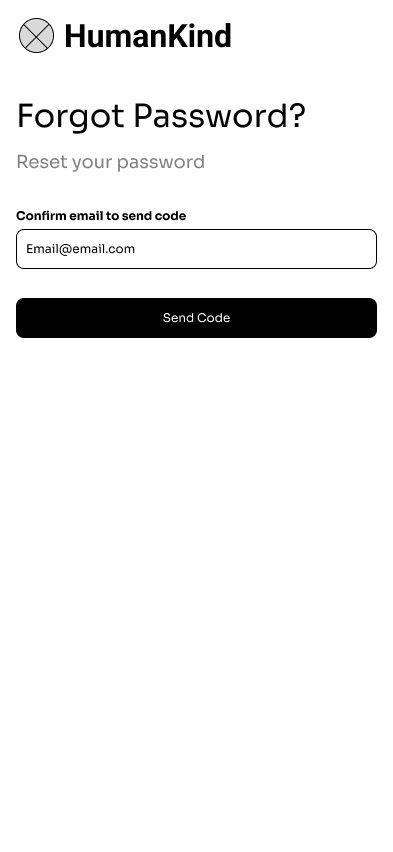
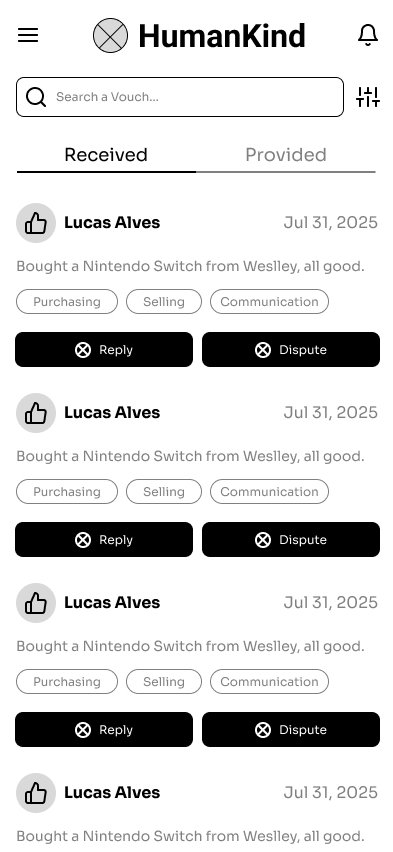
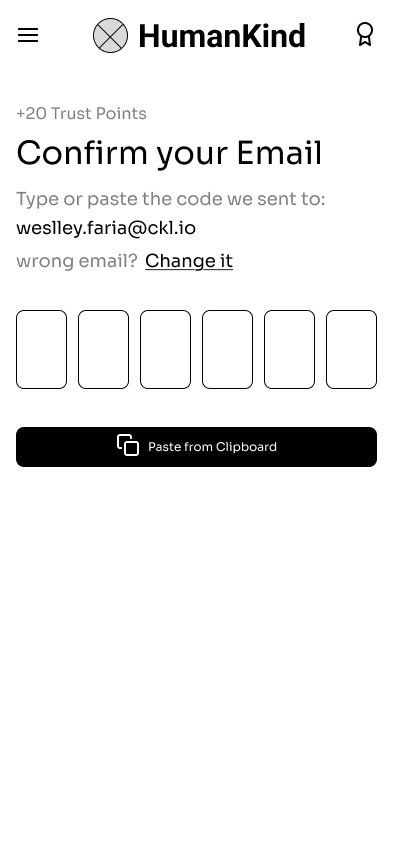
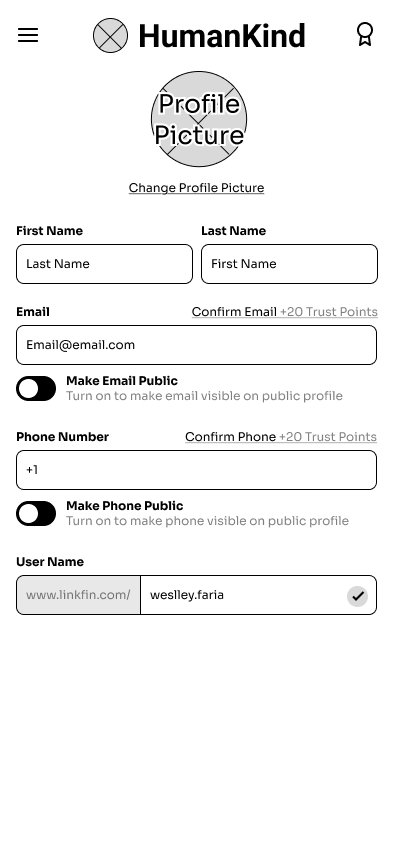
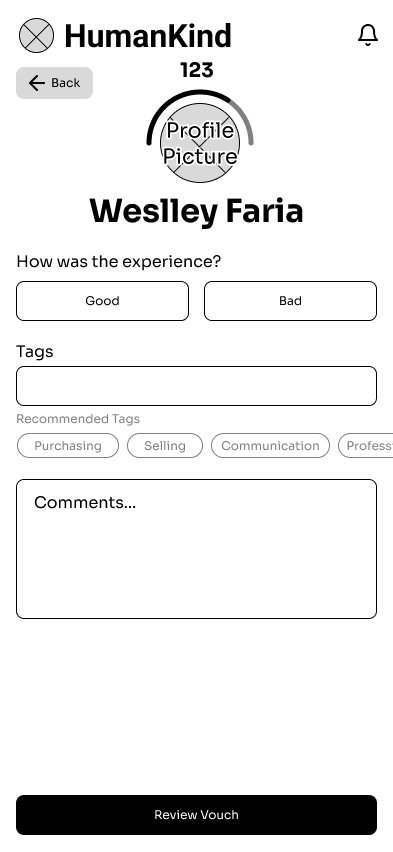
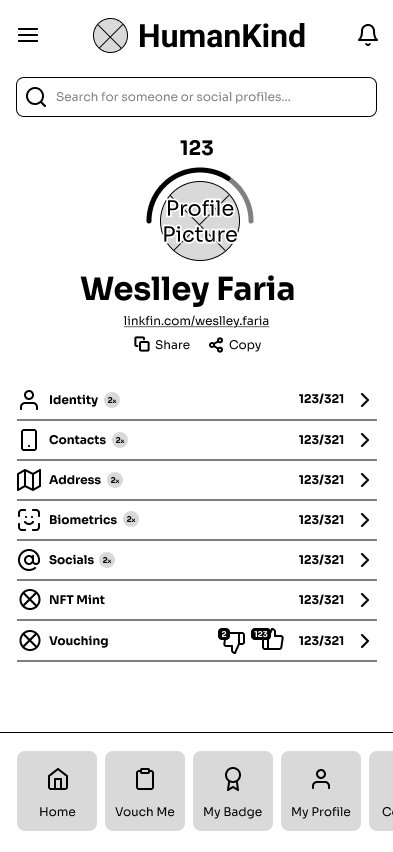
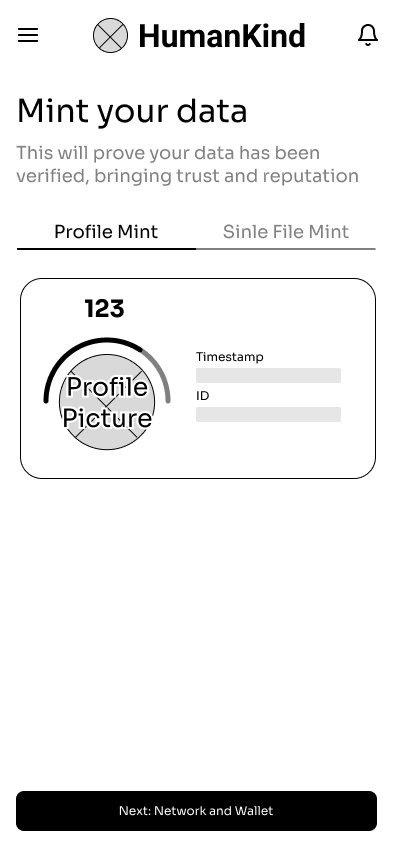
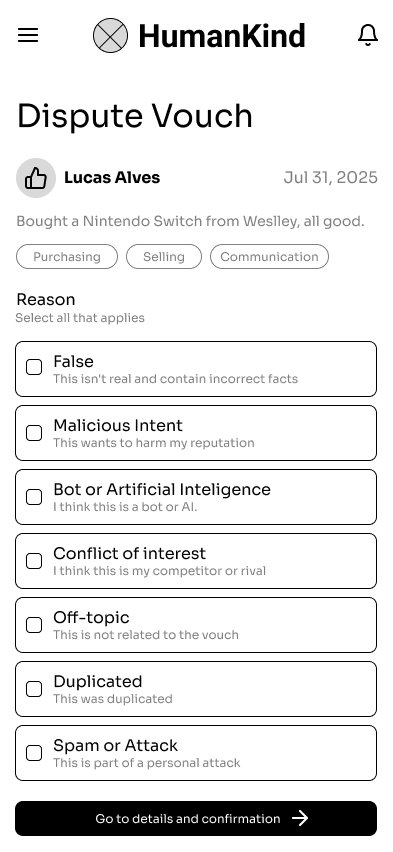
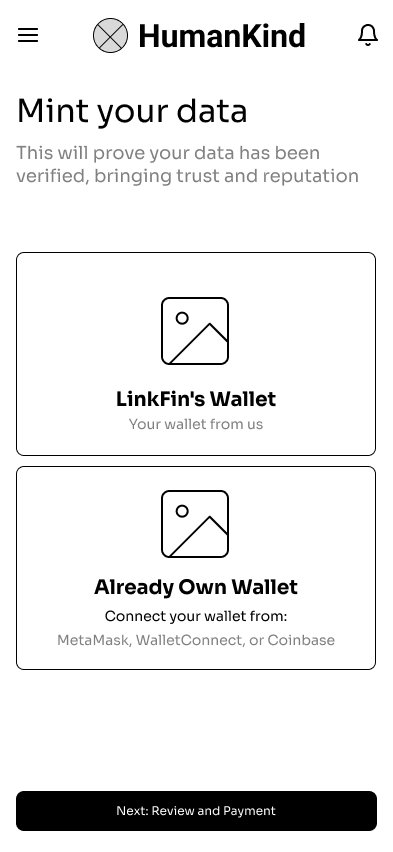
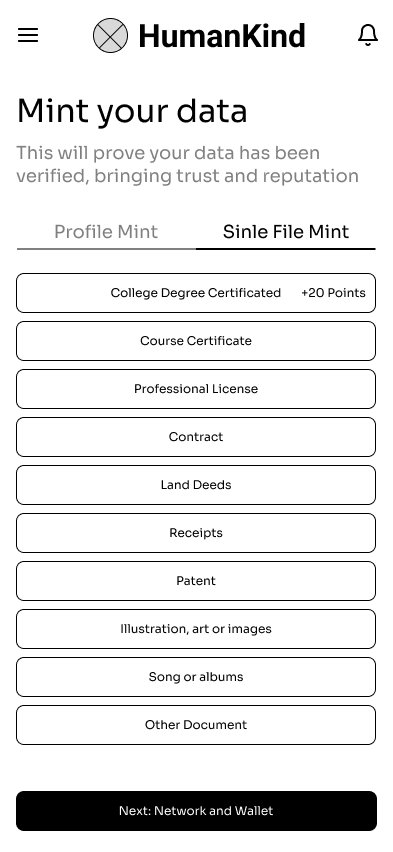
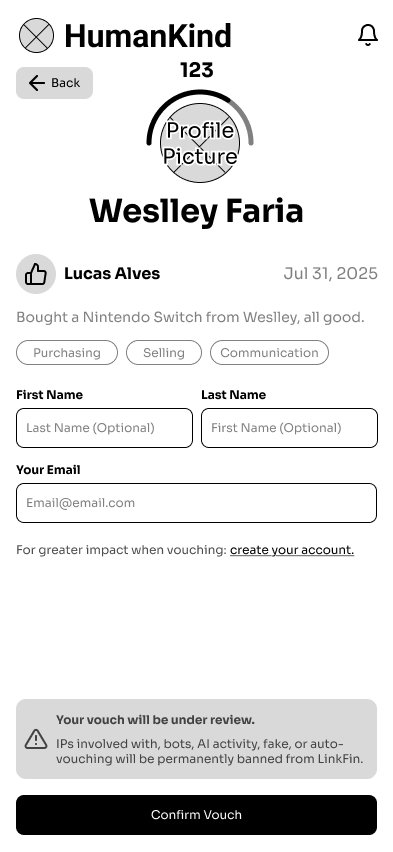
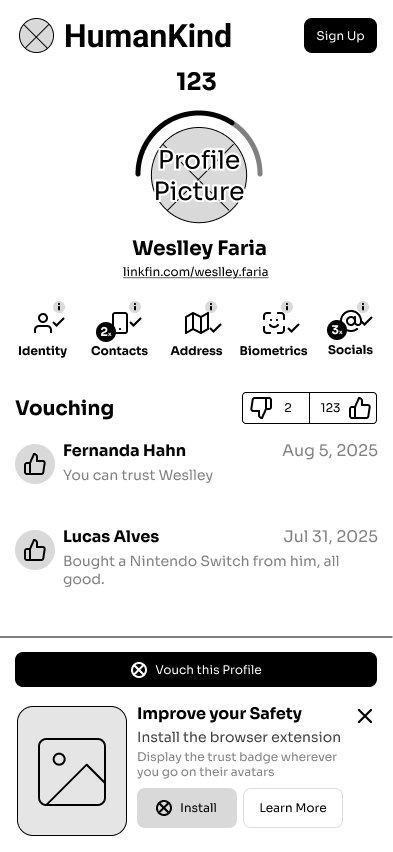
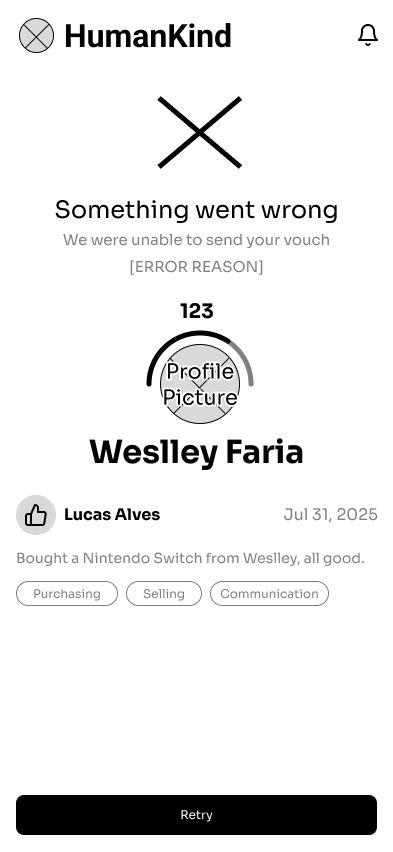
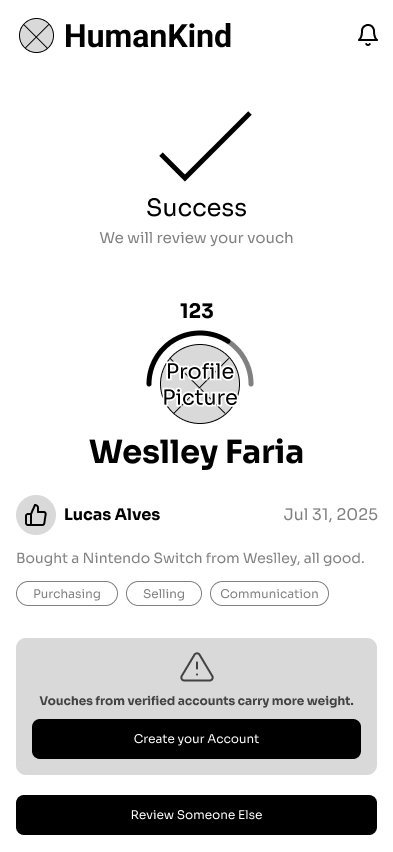
Wireflow
Helps me visualize the flow and if anything is missing
Outcomes
The impact of discovery
User Story
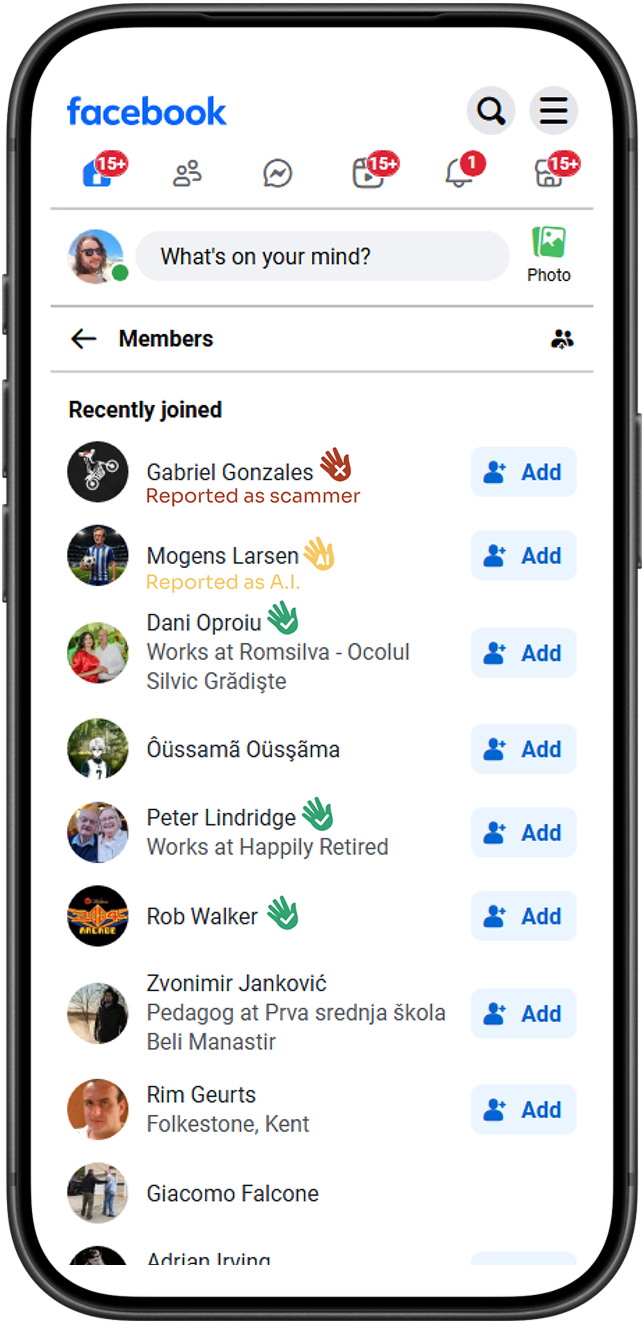
"I want to know who I can trust online"
Problem Validation
The discovery proved that:
There is a need
Users suffer from fake profiles, bots, deepfakes.
Contexts
In cartain contexts the pain is higher
Openness
There is oppeness to verification signals
Clear MVP definition
We left something extremelly wide to an executable product, reducing the risk
- Low friction verification
- Trust tiers
- Contextual Badge
- Integration with existing platforms
UX Metrics
SUS - System Usability Scale

Trust Perception Score
We valued before and after the verification
We asked users to rate a profile:
Without extension
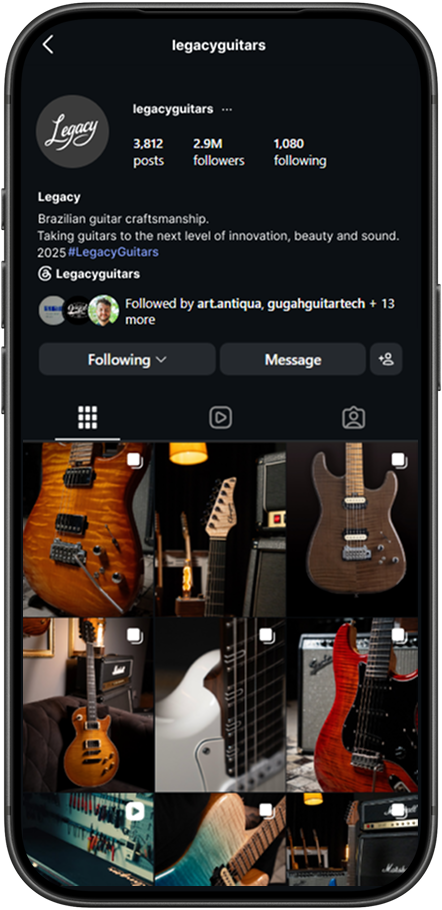
Result
4.3/10
With extension.
Result
7.6/10
Understanding Speed
Because we had conceitual confusion, we did this test on these pages:
Extension Store
App Store
Landing Page
And we asked then: "How would you explain this product to a friend?"
Understanding Criteria
- User understands what a extension is
- User understands that the extension works on certain web browsers
- User understands that the extension doesn't work on apps
- User understands the extension works on third party platforms
- User understands their information can kept private or public
Extension Store
| User | Time | Understood? |
|---|---|---|
| User 1 | 31s | Yes |
| User 2 | 128s | Partial |
| User 3 | 38s | Yes |
| User 4 | 33s | Partial |
| User 5 | 157s | Yes |
Average Time to Understanding
1:17m
Target: 1 to 2 Minutes
App Store
| User | Time | Understood? |
|---|---|---|
| User 1 | 14s | Yes |
| User 2 | 18s | Yes |
| User 3 | 11s | Partial |
| User 4 | 34s | Yes |
| User 5 | 28s | Yes |
Average Time to Understanding
21s
Target: Under 30s
Landing Page
| User | Time | Understood? |
|---|---|---|
| User 1 | 17s | Partial |
| User 2 | 16s | Yes |
| User 3 | 38s | Yes |
| User 4 | 18s | Yes |
| User 5 | 19s | Yes |
Average Time to Understanding
21.6s
Target: Under 30s
Clarity Score
“How clear was this product to you?”
Perceived Privacy Safety
After the user understood about us, we asked:
“How safe do you feel sharing your data with this company?”
Decisions Made
Strategic repositioning of the product
The idea pivoted for something smaller and more feasible to be accomplished
Blockchain doesn't increase trust
Users don't want another platform (we will embed ourselves)
B2C monitization is weak
Only badge isn't enough